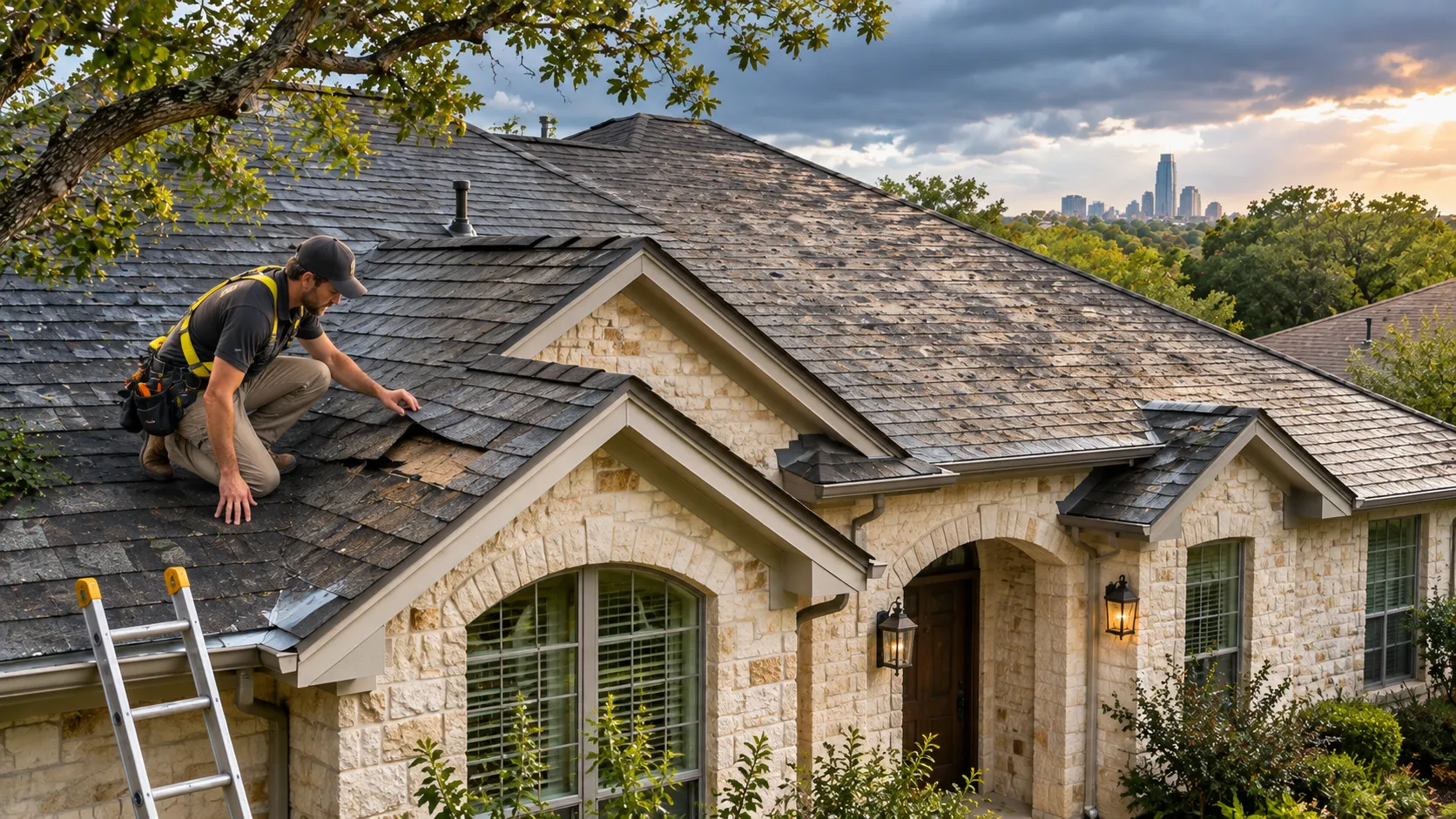
A repair fits damage confined to one spot on a roof with service life left, like a failed flashing, a cracked vent boot, or a few lifted shingles. Replacement fits damage that runs across slopes or comes from age. A roof inspection that checks every slope is the reliable way to tell which one you have.
Key Takeaways
- Repair fits contained damage on a roof that's still sound. Replacement fits damage spread across slopes or caused by age.
- Hail is judged by the pattern across each slope, so a roof that looks fine from the driveway can still be compromised.
- With an insurance claim in play, get the roof inspected before anyone repairs anything.
- Emergency temporary roof tarping stops water now and keeps both options open.
- The costliest choice is usually the one you postpone, because water reaching the decking turns a small job into a large one.
Why Is This Decision So Hard to Make From the Ground?
You're standing in the driveway looking at a ceiling stain, or a few shingles scattered across the lawn after a storm, and you're worried about two things: paying for a replacement you didn't need, or paying for a repair that fails next year. That worry makes sense, because most roof damage can't be seen from the ground.
Bruised shingles from hail still look intact. A leak can travel along a rafter and show up several feet from where water actually gets in. So homeowners tend to judge by the symptom, when the real question is the condition of the whole roof. You're being asked to choose a scope of work before anyone has measured the problem.
A professional roof inspection closes that gap before you spend anything. Roof It Pros offers a free roof inspection, and you can ask the inspector to explain what they find on each slope and what it means for your options.
What Actually Decides Between Repair and Replacement?
Small damage isn't automatically a repair job. What decides it is whether the surrounding roof can hold the repair. A patch is only as good as the material it's fastened into, and aged, brittle shingles often crack when a roofer lifts them to slide new ones underneath. The repair then creates fresh damage around itself.
Three questions sort most situations:
- How much of the roof is affected? Damage on one slope or one detail, such as a vent, valley, or flashing, points toward repair. Damage on two or more slopes points toward replacement.
- What condition is the material in? Pliable shingles with intact granules can take a repair. Curling, cracking, or heavy granule loss means the whole roof is wearing out, not just the area where you found the leak.
- What's the repair history? Three patches on a roof that keeps leaking mean the roof is the problem.
Some roofs sit in between, near the end of their life with only minor damage. There, the question is whether a repair buys real time or only delays an unavoidable bill. For more on that logic, see our guide on how Austin homeowners can make the right call on their roof.
How Does Hail Change the Answer?
Hail breaks the "small damage means repair" rule. Impacts bruise the shingle mat and knock off granules, and the damage often covers whole slopes, especially those facing the direction the storm came from. Because the pattern matters more than any single dramatic spot, each slope has to be checked on its own.
Consider a hypothetical: after a spring storm, you find three dented vents and assume you need three small repairs. A slope-by-slope check then turns up bruising on the sides that faced the wind. The vents were the visible part of a wider problem. Whether that's true on your roof is exactly what an inspection answers.
For the decision points in detail, read our breakdown of hail damage roof repair in Austin.
What Should You Do Before Anyone Touches the Roof?
If water is coming in, stop the water first. Roof It Pros provides prompt emergency temporary tarping for leaks, storm damage, and other urgent issues. A tarp keeps the area dry without committing you to a repair or a replacement.
Then have the damage looked at before permanent work begins. This matters most with an insurance claim, because a repair made before an adjuster sees the roof can erase the evidence that supported a larger scope. Bring your roofer in before the adjuster visit, not after the denial. The claim stays in your name, and Roof It Pros helps homeowners understand their roof's condition so they know what to ask their insurer.
If you're weighing a claim, start with this guide to a roof inspection that sorts repair from replacement, then contact Roof It Pros as soon as you spot trouble.
What Does Each Option Cost, and What Does Waiting Cost?
Roof It Pros doesn't publish fixed prices here, because the cost of either option depends on roof size, pitch, materials, the number of penetrations, and the condition of the decking once it's exposed. A flat number in an article would be a guess. What can be said precisely is how the costs behave:
- A repair costs less up front because the scope is small. It stays good value only if the surrounding roof can hold it.
- A replacement covers the whole roof, so it resets the roof's service life and ends the cycle of patching.
- Waiting has no fixed price, which is the problem. Water that gets past the shingles soaks the decking and insulation, and a repair-sized job becomes a decking replacement plus interior repair.
An inspection ties any estimate you receive to what was actually found, rather than to a guess.
How Do Your Options Compare?
| Approach | What you get | Risk to you |
|---|---|---|
| Inspect with Roof It Pros, then act | A free inspection and a clear picture of the roof's condition before you commit | Low: the decision rests on evidence |
| Temporary tarping, then inspection | Water stopped now, with repair, replacement, and claim options still open | Low: the interior is protected while you decide |
| Wait and watch | Nothing | High: water spreads unseen into decking, and late reporting can weaken a claim |
| Patch it yourself or hire unqualified help | A visible fix for a visible symptom | High: hidden damage goes unchecked, and an early repair can erase claim evidence |
The expensive option is the one you postpone. Acting after a proper inspection is the lowest-risk path in every row.
Does Roof Type Change the Decision?
Yes. Shingle roofs are judged on age, granule loss, and impact. Roof It Pros works with asphalt shingles, metal roofing, tile, and more, and each fails differently. Metal roofs often need attention to fasteners, sealants, or panels, so see our guides on metal roof repair versus replacement and metal roof repair in Austin. Commercial flat roofs such as TPO, EPDM, and modified bitumen are judged by seam condition, ponding water, and moisture in the membrane. Business owners and property managers can start with commercial roofing in Austin.
A roof patched into a corner often costs more across several years than one decisive replacement. When replacement is the answer, our roof replacement service page explains the process.
When Does This Matter Most?
This matters most when you have storm damage, an aging roof, an active insurance claim, or leaks that keep returning. In those situations a wrong guess is expensive and hard to undo.
Straight talk on limits: no article can see your decking, and no one can promise what an insurer will approve. That decision rests with the insurer, based on your policy and the documented damage. What an inspection can do is give you clear findings, so you know which questions to ask. For targeted fixes, our roof repair service covers what's involved.
Roof It Pros has more than ten years in the roofing industry and a 5/5 Google rating from 80+ reviews from Austin and neighboring areas. Contact Roof It Pros for a free inspection, and decide with the facts in front of you.
Frequently Asked Questions
How do I know if my roof can be repaired instead of replaced?
If damage is limited to one area and the surrounding shingles are still flexible and intact, repair is usually realistic. If damage spans several slopes, shingles are curling, or the roof is near the end of its service life, replacement is more likely. An inspection confirms which applies.
Is it worth repairing a roof that's 15 or 20 years old?
It depends on condition more than age. A well-kept roof can take a repair, but aged, brittle shingles often fail around the patch. Ask the inspector how the shingles are holding up before deciding.
Will my insurance pay for a full replacement after a storm?
That's the insurer's decision, based on your policy and the documented damage. Widespread hail or wind damage supports a replacement claim better than isolated damage does.
Should I tarp my roof or repair it right away?
If water is entering, tarp first. Emergency temporary roof tarping protects the interior without locking in a repair, which matters if a claim is pending.
Can a repair hurt my chances of a replacement claim?
It can, if the repair happens before the damage is documented. Getting the roof inspected first keeps the evidence intact.
Does a leak always mean I need a new roof?
No. Many leaks come from flashing, vents, or a single failed seal. Repeated leaks in different spots across the roof point toward replacement.
How much does a roof inspection cost?
Roof It Pros offers a free roof inspection, so you can learn your roof's condition before making any decision.
About the Author
Brandon Miles is the CEO of Roof It Pros, a roofing company serving Austin and Central Texas from 12711 Descartes Cove, Austin. His team handles inspections, repairs, replacements, and storm damage work for homes and commercial properties, with a focus on honest guidance, quality workmanship, and clear communication.