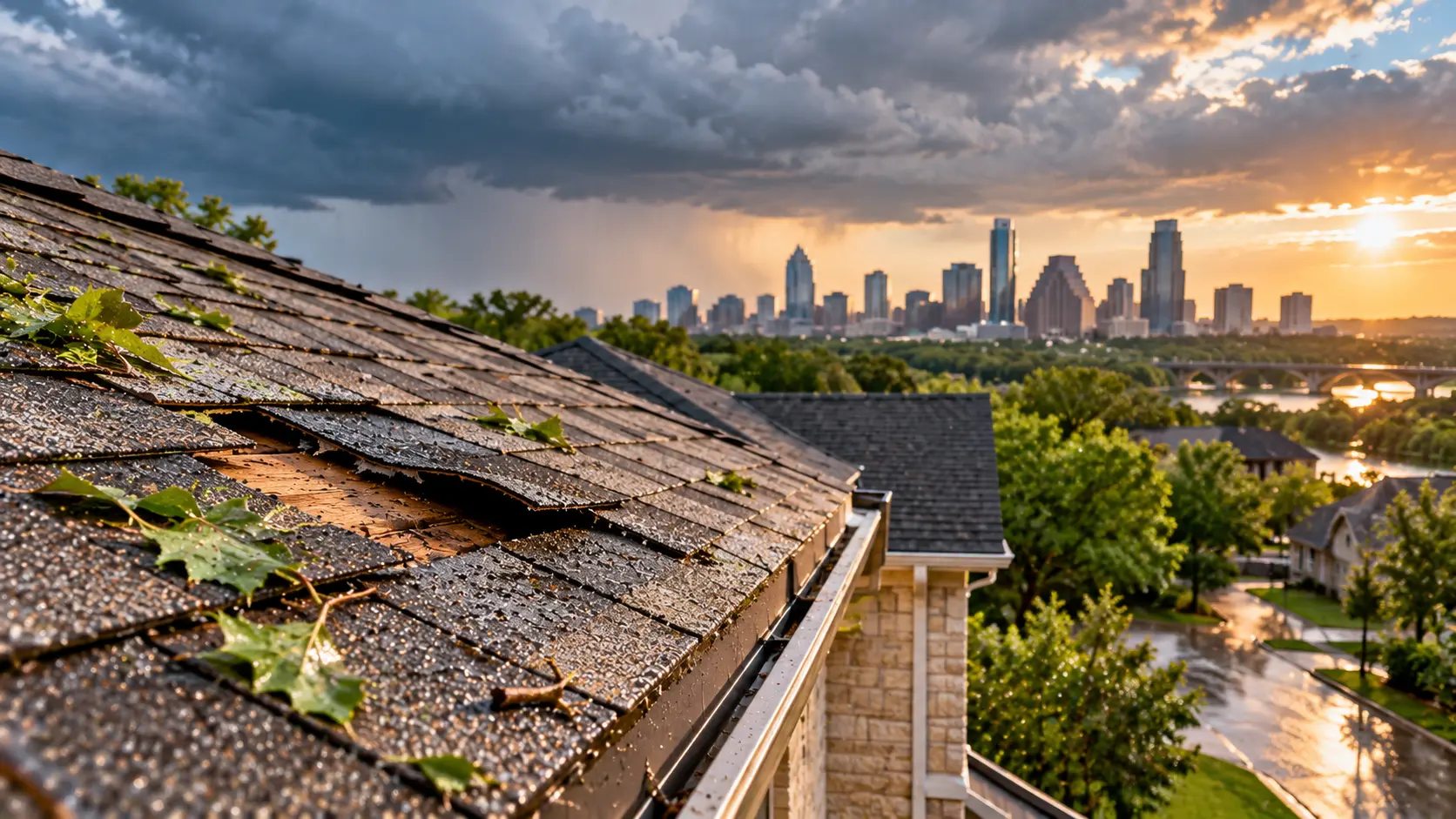
When you’re standing in your driveway after a storm, trying to decide whether you need a $600 repair or a $12,000 replacement, the honest answer is that you can’t know from where you’re standing. The right call depends on two things: how much of the roof system is affected, and whether the structure underneath is still sound. Everything else is a guess.
Key Takeaways
- What you can see from the ground tells you almost nothing about what’s actually failing
- The real deciding factor between repair and replacement is whether damage is isolated or systemic, not how severe it looks from the street
- Age combined with storm impact, granule loss, or flashing failure often signals replacement, even when no single area looks catastrophic
- Texas storm events frequently qualify for full insurance-covered replacement, not just patch repairs
- A professional inspection is the only way to get a real answer, and Roof It Pros offers free evaluations with same-day availability
Why Do So Many Austin Homeowners Get This Wrong?
They’re making a $10,000 decision with zero real information.
After a storm, most homeowners walk the perimeter, look up, spot a few obvious problem areas, and assume those spots are the whole story. That assumption is almost always wrong, and it’s the most expensive mistake you can make in a roofing decision.
The real threat from Central Texas hail and wind events is what you can’t see from street level. Hail impact bruises asphalt shingles in ways that accelerate granule loss and shorten a roof’s remaining life by years without punching a visible hole. Flashing failures around chimneys and penetrations leak slowly, soaking the deck underneath long before a water stain appears on your ceiling. By the time you notice something inside the house, the damage has been building for months.
The most expensive roofing mistake isn’t picking the wrong material. It’s choosing repair when the system is already failing and paying for the same problem twice.
A professional roof inspection in Austin is the only tool that gives you the actual picture. At Roof It Pros, that starts with a free evaluation, because the decision you make afterward should come from real findings, not a guess made from the driveway.
What Actually Determines Whether You Repair or Replace?
Think of it as two questions asked in sequence. First: how much of the roof surface is affected? Second: is the underlying deck structurally sound?
When both answers point the same direction, the decision is usually clear. When they conflict, that’s where hands-on experience with the specific failure patterns common to Central Texas roofs makes the difference.
Scope of damage. If damage is genuinely confined to one area with no signs of spread to adjacent sections or other roof planes, repair is often the right call. If damage appears across multiple planes or shows up at several unconnected locations, that pattern signals a system-level problem. One storm revealing failure points in three different spots doesn’t mean you need three repairs. It means the roof as a whole has reached a threshold where targeted fixes won’t hold.
Condition of the deck. Even localized surface damage can require replacement if the decking underneath has rotted, delaminated, or lost structural integrity. New shingles installed over a compromised deck won’t perform, because the surface layer is only as good as what’s supporting it. This is the finding that surprises most homeowners, because deck condition is completely invisible from the ground.
Consider a typical scenario: an older asphalt roof takes a significant hail event, and the homeowner notices damage in three spots. A thorough inspection might find that granule loss has spread well beyond those three areas, that the deck beneath two of them shows soft spots suggesting moisture intrusion over time, and that flashing around a vent has been slowly failing in a way that has nothing to do with the storm. In a situation like that, the visible damage isn’t the problem. It’s the signal that a gradual, system-wide failure finally became obvious enough to notice. Patching the surface wouldn’t address any of it.
That gap between “probably fine” and “actively failing” is exactly where the wrong roofing decision costs you the most.
How Do the Two Paths Actually Compare?
| Factor | Acting with Roof It Pros | Waiting, Guessing, or Skipping a Professional Inspection |
|---|---|---|
| Damage scope | Accurately assessed with documentation across the full surface | Unknown, frequently underestimated from ground level |
| Deck condition | Inspected and confirmed before any work begins | Hidden rot or delamination goes undetected until it compounds |
| Insurance coverage | Proper documentation supports what the policy actually covers | Missing documentation narrows what the adjuster can approve |
| Long-term cost | Repair or replacement scoped correctly the first time | Real risk of paying for repair, then paying for replacement anyway |
| Timeline | Same-day inspection available; scope confirmed immediately | Every week of delay lets water intrusion work further into the structure |
| Decision confidence | Based on real findings with before-and-after photos | Based on a guess from the driveway |
The pattern here is consistent: the expensive choice isn’t hiring a professional. It’s making a $10,000 decision without the information to get it right.
What Does a Full Roof Replacement Actually Involve?
Replacement is a complete system removal and rebuild. Every layer comes off, including shingles, underlayment, and in many cases damaged decking sections. New materials go down from the deck up: ice-and-water shield at vulnerable transitions, synthetic underlayment across the full surface, and new shingles or metal panels on top.
If you’re filing an insurance claim, adjuster review adds time to the process, but having thorough documentation ready from the start keeps things moving. At Roof It Pros, we handle that process directly, including detailed before-and-after photos and adjuster coordination. That documentation determines what your claim actually covers, and it’s where most homeowners lose ground when they try to navigate it on their own.
If you’re at the decision point right now, our roofing replacement services in Austin start with a free evaluation so you know exactly what you’re dealing with before any commitment is made.
Does Storm Damage Change the Calculation?
Yes, and this is the part most Austin homeowners don’t fully understand.
When a storm event causes damage that meets an insurance adjuster’s threshold, your policy often covers full replacement rather than just a repair, even when the visible damage looks limited. The reason is that hail and wind damage rarely stays isolated to the sections you can see. Adjusters evaluate the full roof system, and when damage is present across multiple areas, full replacement is frequently the covered outcome.
Waiting after visible storm damage to see if it gets worse is one of the most common and costly decisions Austin property owners make. Hail and wind events compromise a roof’s ability to shed water, and every week between the storm and the inspection makes it harder to establish that the damage is storm-caused rather than pre-existing wear.
With over a decade of experience working directly with insurance adjusters, Roof It Pros documents damage thoroughly and walks homeowners through the claim process from the first call. The residential roofing services we provide go beyond installation. They include the documentation and adjuster coordination that shapes what your insurance actually pays.
If you’ve had a recent storm event in Austin or the surrounding Central Texas area, get an inspection before you file, or before you decide you don’t need to.
What About Metal Roofs?
The same two-part logic applies, but the thresholds shift.
Metal roofing systems, particularly standing-seam installations, have a fundamentally different failure profile than asphalt shingles. They don’t shed granules, they’re less vulnerable to hail bruising, and they don’t degrade on the same timeline. A well-installed metal roof in Central Texas can last far longer than a comparable asphalt system.
But metal roofs do fail, and they fail at specific points: fasteners, seams, and penetrations. Those failures are easy to miss if you don’t know the system. Metal roof repair in Austin is often the right call in situations where an asphalt roof of the same age would need full replacement, because the surrounding panels may be structurally sound even when specific connection points have failed.
If you’re weighing a metal roof installation in Austin as part of a replacement decision, the higher upfront cost reflects a significantly longer replacement cycle and lower long-term maintenance exposure.
Who Should Lean Toward Repair, and Who Should Lean Toward Replacement?
Repair tends to be the right starting point when your roof is under 12 to 15 years old with a solid installation, damage is clearly isolated to one area with no signs of spread, and the deck beneath the damaged section is structurally intact.
Replacement tends to be the right call when your roof is 20 years or older and showing any significant damage, you’re seeing granule accumulation in gutters across the full perimeter, multiple areas show wear even if no single spot looks catastrophic, or you have an active insurance claim for a storm event where replacement may be the covered outcome.
One category worth noting separately: commercial roofing. Flat and low-slope commercial systems use membrane materials that fail through ponding water, seam separation, and membrane punctures rather than granule loss and impact bruising. Applying residential logic to a commercial membrane system leads to the wrong decision. If you’re managing a commercial property in Central Texas, commercial roofing in Austin involves a different assessment process from the start.
And don’t overlook your gutters. A failed gutter system accelerates the kind of water intrusion at the roofline that makes a borderline repair situation into a clear replacement. If your gutters are part of the problem, gutter cleaning in Austin and proper gutter installation are part of a complete solution.
Frequently Asked Questions
How do I know if my roof needs replacing or just fixing after a hail storm?
You genuinely can’t tell from the ground. Hail damage frequently looks minor on the surface while causing the kind of granule loss and impact bruising that shortens a roof’s remaining life by years. The only way to know whether you’re dealing with an isolated repair or a system-wide failure is a professional inspection that checks the deck, flashing, and full surface area, not just the spots you noticed.
Will my insurance pay for full replacement or just repairs?
That depends on the extent of the damage and your specific policy, but in Texas, storm events that cause widespread hail or wind damage frequently result in full replacement coverage. The key is documentation. Adjusters need evidence that damage is present across the full roof system. An inspection with detailed before-and-after photos, completed before you file, significantly affects what the claim covers.
Is it ever worth repairing an older roof instead of replacing it?
Sometimes, but the case for repair weakens as a roof ages. A 10-year-old roof with isolated, confirmed damage to a structurally sound section is a reasonable repair candidate. A roof in its early twenties with even isolated damage is usually a replacement candidate, because the surrounding material is already near the end of its service life. The repair cost often gets absorbed into a replacement within a year or two anyway, which means the savings from choosing repair can disappear quickly.
What’s the difference between a proper repair and a patch job?
A patch addresses the surface symptom. A proper repair addresses the cause, meaning the damaged section gets pulled back, the deck underneath gets inspected, any compromised decking gets replaced, and the area gets reinstalled with correct underlayment and flashing. A patch that skips those steps will fail again, usually faster than the original failure, because the underlying problem was never fixed.
How do I find a trustworthy roofing contractor in Austin?
Look for contractors who start with a documented inspection before recommending any scope of work, provide before-and-after photos, and explain the reasoning behind their recommendation in plain terms. Roof It Pros holds a 5/5 Google rating with 80+ verified reviews from Austin and neighboring areas. That track record comes from treating the inspection as the foundation of every job, not as a formality before the sales pitch.
Does storm damage need to be addressed quickly, or can I wait?
Waiting is almost always the more expensive choice. Once hail or wind compromises a roof’s ability to shed water, intrusion begins working into the deck and framing. The longer the gap between the storm and the inspection, the harder it becomes to establish that damage is storm-caused rather than pre-existing, which directly affects your insurance claim outcome.
Does the repair-versus-replace decision work differently for commercial roofs?
Yes. Commercial flat and low-slope roofs use membrane systems that fail differently than residential shingles. The repair thresholds are different because the materials and failure modes are different. If you’re managing a commercial property in Central Texas, the assessment has to account for those specific patterns from the start, not borrow from the residential playbook.
If you’re in Austin, Pflugerville, or anywhere in Central Texas and you’re not sure whether you’re looking at a repair or a replacement, the answer starts with an honest inspection. Roof It Pros offers free roof evaluations with same-day availability. No predetermined scope, no pressure, just a real assessment with documentation you can use to make a confident decision.
Reach out to schedule your free evaluation and get a real answer.
About the Author
Brandon Miles is the CEO of Roof It Pros, a roofing company serving Austin and Central Texas. With over a decade of experience in residential and commercial roofing, he leads a team built around honest guidance, quality craftsmanship, and genuine care for the homeowners and property managers they serve. Roof It Pros specializes in roof inspections, repairs, replacements, and storm damage restoration across the greater Austin area.