Your roof is the most expensive single component of your home’s exterior, and most people have no idea what condition it’s actually in until something goes wrong. That gap between “probably fine” and “actively failing” is exactly where the wrong roofing approach costs you the most.
Direct Answer
Commercial roofing frameworks fail Austin homeowners and small business owners because they’re built around scale, not urgency. They assume scheduled maintenance cycles, large budgets, and dedicated facilities staff. Residential and small commercial situations in Central Texas require rapid storm response, insurance claim navigation, and transparent communication with a single decision-maker, not a procurement process.
Key Takeaways
- Commercial roofing protocols assume predictable maintenance schedules. Austin’s hail and storm seasons don’t cooperate with that assumption.
- Homeowners and small business owners need insurance claim expertise built into the roofing process, not bolted on afterward.
- Waiting after visible storm damage to “see if it gets worse” is the single most expensive decision most Austin property owners make.
- Annual roof inspections aren’t optional in Central Texas. The weather here is hard enough on roofing materials that skipping a year creates real risk.
- Roof It Pros offers same-day availability, before/after photo documentation, and direct insurance claim handling because that’s what the Austin market actually needs.
What Makes Commercial Roofing Logic Wrong for Your Situation?
Commercial roofing is built around one core assumption: the building owner has time. Time to schedule, time to budget across quarters, time to get three bids, time to wait for a crew to open up.
That assumption breaks immediately when you’re a homeowner in Pflugerville staring at a ceiling stain after a July storm. Or a small business owner in North Austin whose flat roof is pooling water and whose insurance adjuster is asking for documentation you don’t have.
The commercial roofing model is a procurement model. It’s designed for facilities managers with maintenance logs and vendor relationships. When it gets applied to residential or small commercial situations, the result is slow response, opaque pricing, and a process that treats your urgent problem like a scheduled capital project.
The mismatch isn’t about quality. It’s about structure. Commercial roofing frameworks weren’t designed for your situation, and no amount of “premium service” language changes that underlying design.
Why Does This Problem Keep Repeating in Austin?
The root cause isn’t that roofing contractors are bad at their jobs. It’s that most roofing companies grew up doing one thing and then expanded into the other without rebuilding their process.
A company that started in commercial work brings its commercial habits with it: longer estimate windows, formal scopes of work, and a communication rhythm that assumes you’ll wait. A company that started residential but scaled fast often loses the thing that made it work, which was the direct contact between the person doing the work and the person who owns the house.
Austin’s growth has made this worse. The city has added hundreds of thousands of residents over the past decade, demand for roofing services spikes every hail season, and the contractors who can’t keep up with that pace default to the slower commercial model because it’s what they know.
There’s also an insurance dimension that commercial frameworks miss entirely. Residential insurance claims for roof damage have specific documentation requirements, specific timelines, and specific adjuster dynamics that are completely different from a commercial loss. If your contractor doesn’t know how to work inside that process, you’re doing the hard part alone.
What Does a Roofing Process Actually Built for Austin Look Like?
The right model for Austin homeowners and small business owners has four non-negotiable components.
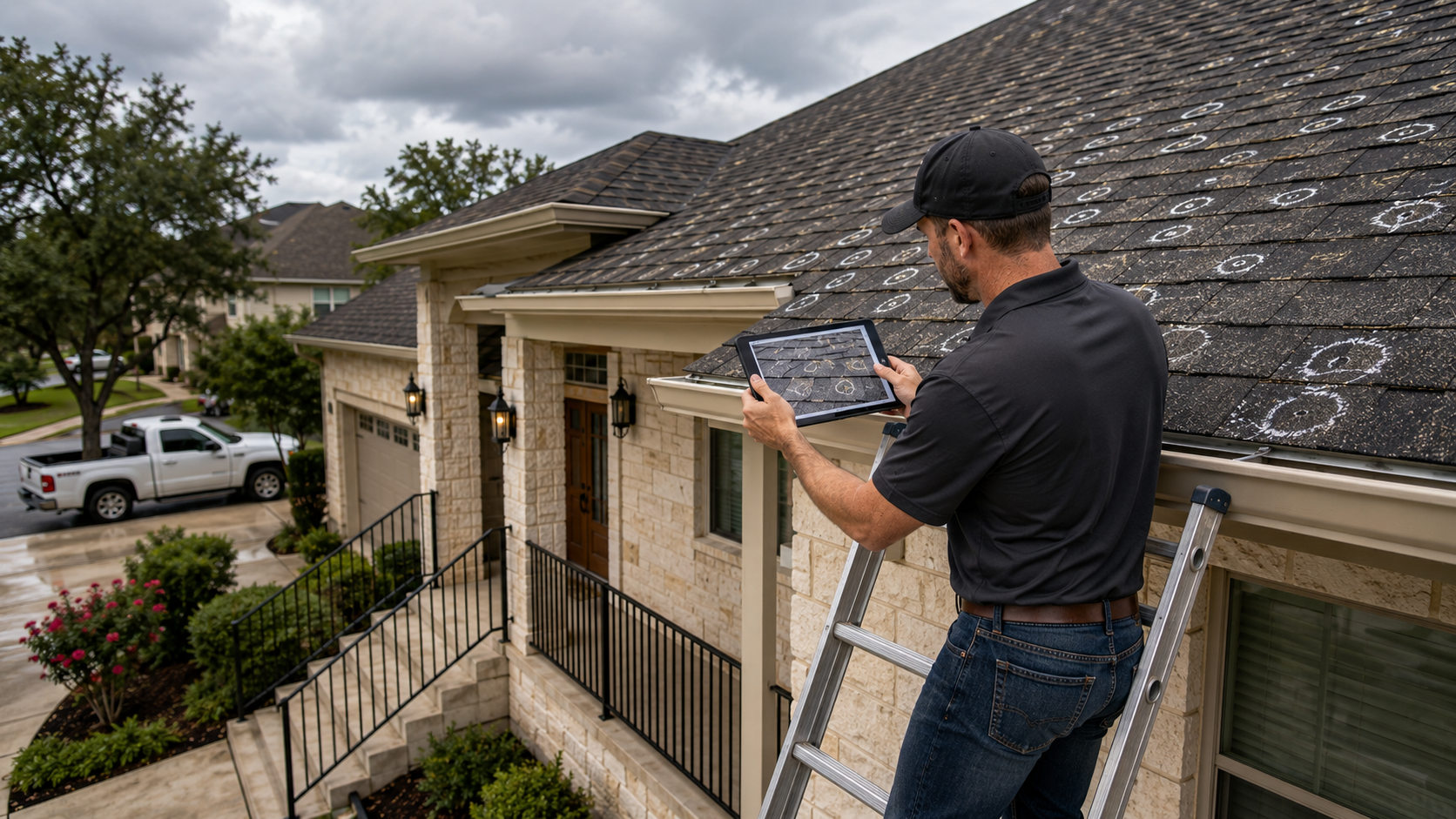
First: same-day or next-day response after storm events. Hail damage that goes undocumented for weeks is harder to claim and harder to repair correctly. The window between the storm and the adjuster’s visit is where documentation matters most. A roofing partner who can get on your roof the same day, photograph every impact point, and provide a written assessment before the adjuster arrives is worth significantly more than one who calls back in three days.
Second: built-in insurance claim handling. This doesn’t mean the contractor files the claim for you. It means they understand what adjusters look for, they document damage in the format that supports your claim, and they can walk you through the proper insurance and payment process without you having to figure it out on your own. Most homeowners have no clue what that process looks like. A contractor who can teach you is a different category of help.
Third: transparent, line-item pricing. Not a ballpark. Not “we’ll know more when we start.” A real scope of work with real numbers before anything gets approved. This matters especially when you’re dealing with an insurance payout that has specific line items the insurer will and won’t cover.
Fourth: direct communication with the person doing the work. Not a call center, not a scheduling coordinator who relays messages. The ability to reach someone who knows your roof, knows your claim status, and can give you a straight answer.
If you’re evaluating whether your current roofing situation needs attention, a professional roof inspection in Austin is the right starting point. It gives you documentation, a clear picture of what’s actually happening up there, and a baseline for any insurance conversation.
The Inspection Gap: Why “It Looks Fine” Is Not a Roofing Strategy
Here’s the contrarian claim worth sitting with: the roof that looks fine from the ground is often the one that costs the most to deal with later.
Hail damage in Central Texas frequently doesn’t look like damage to an untrained eye. It looks like normal wear, or it’s invisible from street level entirely. The granule loss, the cracked substrate, the compromised flashing around vents and chimneys, all of that is happening whether you can see it or not. By the time a leak appears inside the house, the damage has usually been progressing for months.
Annual inspections aren’t an upsell. They’re the only way to know what you’re actually dealing with before it becomes an emergency. Texas weather is hard enough on roofing materials that treating an inspection as optional is genuinely risky.
The team at Roof It Pros works with residential homeowners across Austin who come in thinking they need a minor repair and discover the underlying issue is two seasons old. The repair is still possible, but it’s more involved than it would have been with earlier documentation.
If you’ve had any significant weather events in the past 12 months and haven’t had someone on your roof since, that’s the situation to address first.
The Roof Readiness Triage: A Decision Framework for Austin Property Owners
The Roof Readiness Triage is a three-question framework for deciding what kind of roofing attention your property needs right now, and how urgently.
Use it when you’re not sure whether you’re dealing with a repair, a replacement, or a documentation issue.
Question 1: Has your area experienced a named hail or wind event in the past 12 months?
If yes, you need a documented inspection regardless of whether you’ve seen interior symptoms. Hail damage is frequently invisible from the ground and only shows up in an adjuster’s report if it’s been documented by a contractor first.
Question 2: Is your roof more than 15 years old?
Asphalt shingles in Central Texas face extreme UV exposure and temperature cycling. A roof past 15 years that hasn’t been inspected recently is a liability, not just an aging asset. This is the threshold where roof replacement in Austin becomes a realistic conversation rather than a distant one.
Question 3: Do you have an active insurance claim or a pending adjuster visit?
If yes, stop waiting and get a contractor-generated damage assessment in hand before that visit. The adjuster’s job is to assess the loss accurately, but they’re working from their own documentation. Having yours changes the dynamic.
| Situation | Right Action | Wrong Action |
|---|---|---|
| Post-storm, no visible damage | Schedule inspection immediately | Wait to "see if anything develops" |
| Roof over 15 years old | Get inspection, discuss replacement timeline | Patch and defer |
| Active insurance claim | Get contractor documentation before adjuster visit | Let adjuster set the scope alone |
| Visible interior leak | Emergency repair call, same day | DIY patch while waiting for a quote |
| New home purchase | Pre-occupancy inspection | Assume the inspection report covered it |
What a Realistic Outcome Looks Like
Consider a typical scenario in Austin’s storm season. A homeowner in Pflugerville gets quarter-sized hail in a spring storm. No interior damage, no missing shingles visible from the street. They wait two months, file a claim, and the adjuster comes out. By that point, there’s no contractor-generated documentation of the immediate post-storm condition, and the adjuster’s assessment is the only record.
With same-day documentation from a contractor, that same homeowner has photographic evidence of every impact point, a written assessment of granule loss and substrate damage, and a scope of work that the adjuster can review against their own findings. That documentation doesn’t guarantee a different outcome, but it gives the homeowner a real position in the conversation.
Roof It Pros provides exactly that kind of before/after photo documentation as a standard part of the process, not as an add-on. It’s the mechanism that makes insurance claim handling actually work for the homeowner, not just for the insurer.
If you’re dealing with storm damage right now, the right move is a call, not a wait. Certified roof repair professionals in Austin can assess the damage, document it properly, and walk you through what comes next.
Who This Approach Doesn’t Fit
Straight talk: if you’re looking for the lowest bid on a job you’ve already scoped yourself, this isn’t the right fit. Roof It Pros works best with homeowners and business owners who want a professional to assess the situation honestly, handle the insurance process correctly, and communicate throughout.
If you’re planning to DIY the repair or you already have materials and just need installation labor, that’s a different kind of project. The value here is in the full-service approach: inspection, documentation, claim support, and quality installation from a team that’s been doing this in Central Texas for over 10 years.
For small business owners with flat or low-slope roofs, the commercial roofing services in Austin are built around the same principles: fast response, transparent scoping, and documentation that supports your insurance process.
The roof that fails quietly is the one that costs the most. Waiting for a visible symptom isn’t a strategy; it’s a delayed expense.
If you’re in Austin or Pflugerville and you’re not sure what condition your roof is actually in, that uncertainty is the thing to resolve. Roof It Pros has a 5/5 Google rating with 80+ verified reviews, same-day availability, and a team that will give you a straight answer about what you’re dealing with.
Call Roof It Pros or request an inspection online. Get the documentation before you need it, not after.
About the Author
Brandon Miles is the CEO of Roof It Pros, a family-owned roofing company serving Austin and Central Texas. He has been building his business around honest guidance and quality craftsmanship since 2010, with extensive experience in residential and commercial roofing, storm damage restoration, and insurance claim support. Roof It Pros serves homeowners and small business owners across Austin, Pflugerville, and the surrounding Central Texas area.