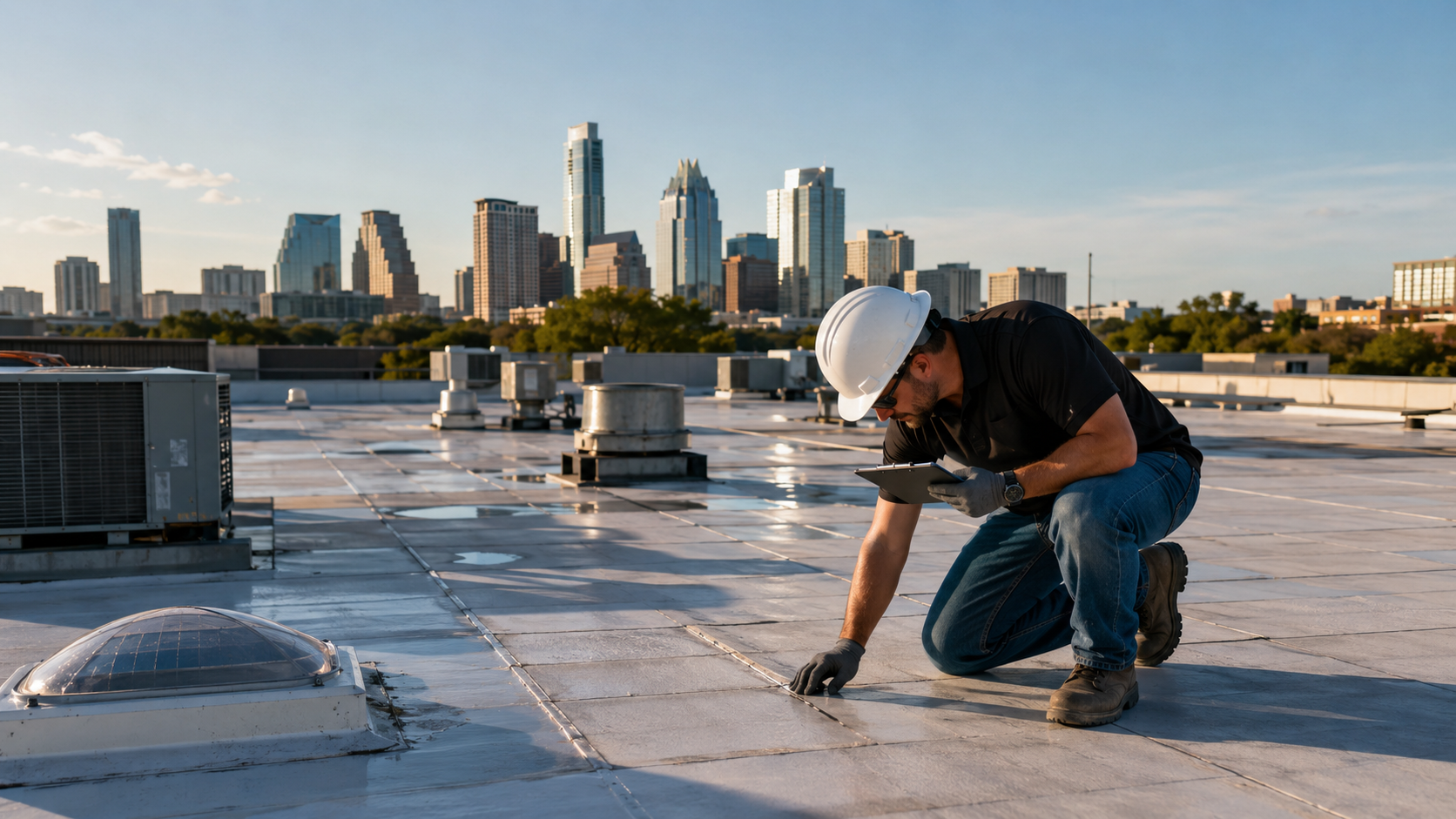
Your commercial roof is probably the single largest maintenance liability on your property, and most business owners don’t find that out until something goes wrong. A leak during a summer storm, a failed inspection, a tenant complaint that turns into a repair bill you weren’t expecting. By then, the conversation has shifted from ROI to damage control.
The good news: when you approach commercial roofing as a business decision rather than a reactive expense, the math changes considerably.
What ROI From Commercial Roofing Actually Means
Commercial roofing ROI isn’t just about avoiding leaks. It’s the combined return from reduced repair frequency, lower energy costs, protected property value, avoided business interruption, and stronger insurance positioning. Strong results typically come from catching problems early, using materials matched to your building type, and working with a contractor who documents everything. Weak results come from deferring decisions until damage forces them.
Key Takeaways
- Deferred maintenance on a commercial roof almost always costs more than the repair it was avoiding
- The gap between strong and weak roofing ROI comes down to timing, material selection, and documentation quality
- Insurance claims on commercial properties require detailed before/after documentation to avoid underpayment
- A professional inspection at least once a year is the baseline for any commercial property in Central Texas
- Same-day service availability matters more than you’d think when active water intrusion is involved
Why Do So Many Commercial Roofing Projects Underdeliver?
The honest answer: most commercial roofing projects underdeliver because the decision to act comes too late.
By the time a business owner calls a roofer, the roof has usually been failing quietly for months. A small penetration becomes a saturated substrate. A minor flashing gap becomes a ceiling stain. A ceiling stain becomes a conversation with your insurance adjuster about what was “pre-existing.” The repair that would have cost $800 in March is now a $6,000 replacement section in August.
Deferred maintenance doesn’t pause the clock. It just shifts who pays.
This is the root cause pattern behind weak commercial roofing ROI: not bad contractors, not bad materials, but decisions made reactively instead of proactively. The building tells you what it needs. Most owners aren’t listening until it’s loud.
A typical case: a retail strip in Pflugerville with a flat TPO roof that’s been on the building for 11 years. No documented inspections. The owner calls because of a ceiling stain in one unit. An inspection reveals three separate penetration failures, two areas of standing water from drainage issues, and membrane shrinkage around the HVAC curbs. What looked like a $1,500 repair is now a $14,000 partial replacement. The drainage issue alone could have been caught and corrected for under $400 two years earlier.
What Does Strong Commercial Roofing ROI Actually Look Like?
Strong ROI from commercial roofing has a specific profile. It doesn’t look like a single dramatic outcome. It looks like a pattern of avoided costs, sustained asset value, and predictable maintenance spend.
Here’s what that pattern includes:
- Inspections that catch minor failures before they saturate insulation or damage interior finishes
- Material selection that matches the roof’s actual use (foot traffic, HVAC load, drainage slope)
- Documented condition history that supports insurance claims and increases claim payout accuracy
- Repairs completed before water intrusion compromises structural decking
- A contractor who communicates what they found, what they did, and why, with photos
The commercial roofing services Roof It Pros provides in Austin are built around this pattern. The documentation piece is one most contractors skip. It matters enormously when you’re filing a claim.
The Commercial Roofing ROI Scorecard
The Commercial Roofing ROI Scorecard is a decision framework for evaluating whether your current approach to roof maintenance is generating positive or negative returns. Use it when you’re deciding whether to repair, replace, or continue deferring.
Score your situation across five factors:
| Factor | Strong ROI Signal | Weak ROI Signal |
|---|---|---|
| Inspection frequency | Annual or after major storms | Never, or only when something fails |
| Repair timing | Proactive, before interior damage | Reactive, after visible damage |
| Documentation | Full before/after photo record | No documentation on file |
| Material match | Specified for building type and use | Whatever was cheapest at the time |
| Contractor communication | Written scope, clear timeline | Verbal only, no follow-up |
If you scored three or more weak signals, you’re not getting ROI from your roof. You’re accumulating deferred liability.
Does Timing Actually Change the Cost That Much?
Yes. And the mechanism is worth understanding, because it’s not just about the repair itself.
When water gets through a commercial roof membrane, it doesn’t stop at the surface. It travels. It saturates rigid insulation boards, which loses its R-value and can’t be dried out effectively. It reaches decking, where it causes rot or rust depending on the substrate. It finds interior finishes, electrical conduit, inventory, tenant space. Every additional week of active intrusion expands the damage footprint.
The cost difference between catching a flashing failure at six months versus eighteen months isn’t linear. It’s often 4x to 10x, because you’re no longer replacing a $200 piece of flashing. You’re replacing insulation, patching decking, repainting ceilings, and potentially dealing with a tenant’s loss-of-use claim.
Roof It Pros offers same-day service availability specifically because water intrusion is a time-sensitive problem. Waiting a week for a contractor to show up isn’t a minor inconvenience. It’s a week of expanding damage.
If you’re already seeing signs of failure, a professional roof inspection in Austin is the right first move. Not a quote. An inspection. You need to know what you’re actually dealing with before you can make a sound decision.
What’s the Difference Between a Repair and a Replacement Decision?
This is the question business owners ask most often, and it’s the right one.
Repair makes sense when the failure is localized, the surrounding membrane is structurally sound, and the roof has meaningful remaining service life. Replacement makes sense when the membrane has reached end-of-life, when repairs have become a recurring pattern on the same sections, or when the total repair cost approaches 25-30% of replacement cost.
The honest answer is that most commercial roofs in Central Texas are repaired when they should be replaced, and a smaller number are replaced when a targeted repair would have added five more years of service life. Both mistakes are expensive.
Consider a case where a business owner has been patching the same 400-square-foot section of a flat roof every 18 months for six years. The cumulative repair spend has reached $9,000. A full replacement of that section would have cost $7,500 at the first repair. The ROI math on that decision is straightforward in hindsight.
A roof replacement evaluation from Roof It Pros includes an honest assessment of remaining service life, not just a quote for the most expensive option. That distinction is worth asking about when you’re getting bids.
If you’re managing a commercial property and want a clear picture of where your roof actually stands, reach out to Roof It Pros for a professional inspection. You’ll get documented findings, not a sales pitch.
What About Insurance Claims on Commercial Roofs?
Commercial property insurance claims for roof damage are where the documentation gap costs business owners the most money.
Insurance adjusters work from evidence. If you don’t have a documented pre-storm condition report, the adjuster has no baseline. Damage that existed before the storm and damage caused by the storm look identical to someone walking the roof for the first time. Without before/after documentation, you’re negotiating from a weak position.
Roof It Pros handles insurance claim documentation as a core part of their commercial roofing process. Before/after photos, written condition assessments, and detailed damage reports give your adjuster a clear record of what the storm actually caused. That documentation is the difference between a full claim payout and a partial one.
Central Texas gets hit hard by hail and wind every year. If your commercial property has taken storm damage and you haven’t filed a claim yet, the certified roof repair team at Roof It Pros can walk you through the documentation process before you contact your carrier.
Who Gets the Worst ROI From Commercial Roofing?
The business owners who get the worst return from commercial roofing share a specific profile: they treat the roof as an invisible asset until it becomes a visible problem.
This isn’t a criticism. It’s a structural issue. Roofs don’t announce their condition. They don’t send alerts. They fail gradually, then suddenly. The owner who’s been in the same building for eight years and has never had a leak has no reason to think the roof is a problem, right up until it is.
The other group that consistently gets poor ROI: owners who hire based on price alone. The cheapest bid on a commercial roof replacement often reflects a material downgrade, a thinner installation crew, or a contractor who won’t be reachable when the warranty question comes up three years later.
Roof It Pros has been in the Austin roofing market for over ten years, with 80+ verified five-star reviews. That track record exists because the work holds up, not because the bids were the lowest in the room.
Limitations: When This Approach Doesn’t Apply
Not every commercial roofing situation calls for the same process. A small repair on a newer roof with documented maintenance history is a straightforward job. You don’t need a full inspection protocol for a two-square patch on a roof that was installed three years ago.
This framework matters most when the roof’s condition is unknown, when you’re dealing with storm damage, when you’re preparing for a sale or lease, or when you’ve had recurring failures in the same area. In those situations, skipping the documentation and inspection steps costs you.
Roof It Pros also works with residential roofing in Austin and handles metal roof installations for both commercial and residential properties. If your building uses metal roofing, the inspection and repair process is different enough that it’s worth asking specifically about metal system experience when you call.