Metal roofing holds up better than most systems in Central Texas. But durable doesn’t mean self-diagnosing. A metal roof can look completely intact from the ground while water is already traveling under a lifted seam or entering through a degraded fastener. Knowing which problem you’re actually dealing with is what determines whether a targeted repair solves it or buys you six months before a larger failure.
Key Takeaways
- Repair makes sense for isolated fastener failures, single-panel damage, or seam issues on a structurally sound roof under 15 years old
- Replacement becomes the right call when corrosion is spreading, fastener degradation is distributed across multiple sections, or the roof deck below has been compromised
- Hail dents near seams and fasteners break the watertight seal in ways that aren’t visible from the ground
- A professional inspection is the only reliable way to distinguish surface-level damage from a systemic failure pattern
- Delaying the repair-vs-replace decision doesn’t buy time. It narrows your options and raises the cost of both paths.
What Actually Fails on a Metal Roof?
Metal roofs fail in three distinct ways. Mixing them up leads directly to the wrong fix.
Fastener failure is the most common problem on exposed-fastener panel systems. Every screw that penetrates the panel surface sits under a rubber gasket designed to keep water out. That gasket degrades from UV exposure and from the thermal cycling Central Texas delivers in concentrated doses. Hot summers followed by sharp fall temperature drops cause panels to expand and contract repeatedly, which works the fastener loose over time. Water enters through the fastener hole itself, not through the panel. That’s why a roof can look completely intact from the driveway and still be letting water in every time it rains.
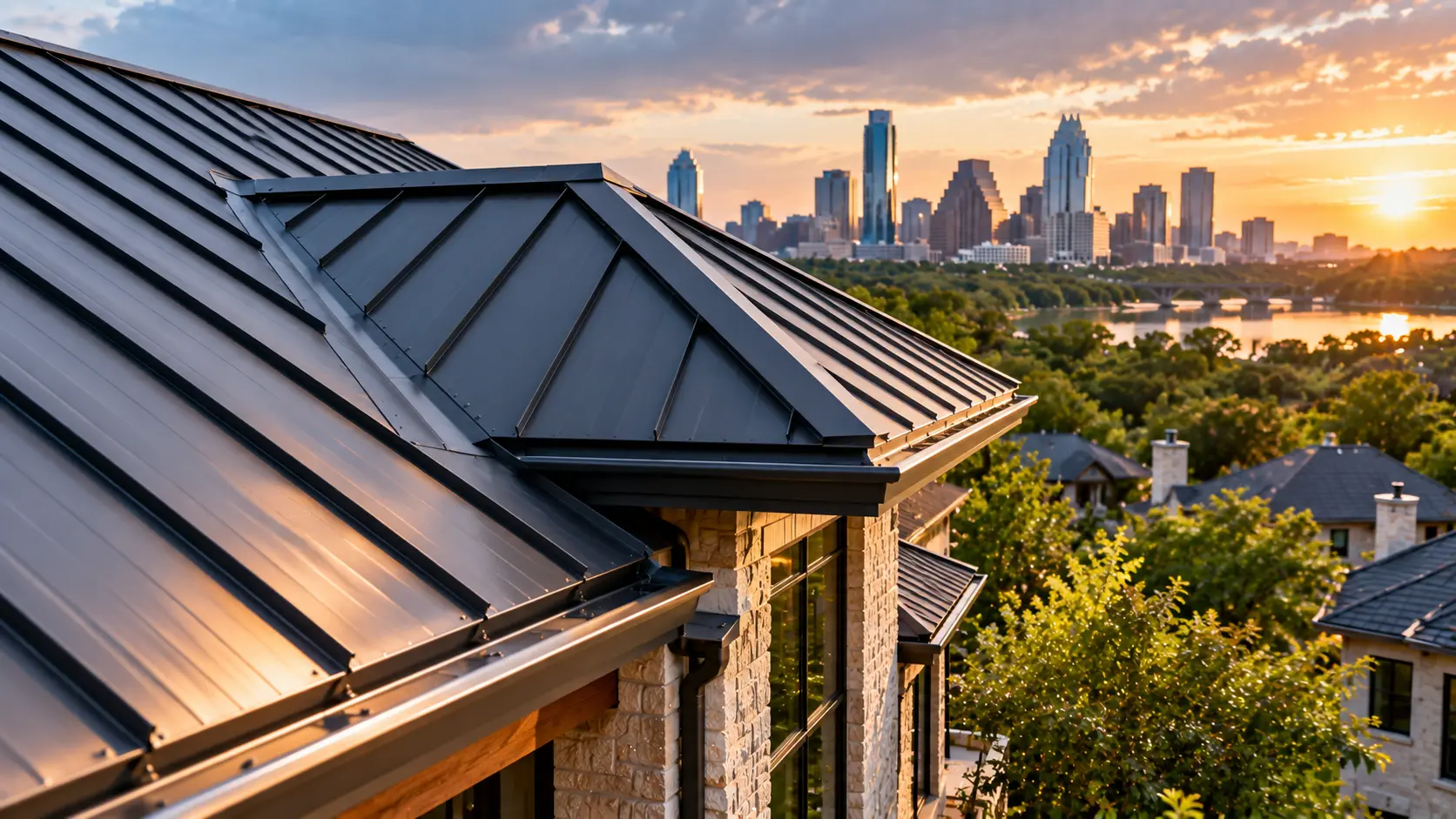
Seam separation is the primary failure mode on standing-seam systems. The panels themselves rarely crack or corrode early in their lifespan, but the mechanical seam locking them together can lift or shift under wind uplift or when the deck moves slightly beneath it. Once a seam opens, water doesn’t drip straight through. It travels laterally under the panel before finding an exit, which means the ceiling stain you notice may have nothing to do with where the breach actually is.
Panel corrosion changes the entire calculation. Surface rust on Galvalume or painted steel is often cosmetic and doesn’t compromise the system immediately. But when corrosion reaches the base metal and spreads across multiple panels, you’re not patching a problem anymore. You’re chasing one.
Most homeowners don’t catch these issues early because metal roofs don’t show distress the way asphalt shingles do. There’s no granule loss, no curling edge, no obvious surface deterioration until the failure is already advanced. Scheduling a professional roof inspection in Austin identifies fastener degradation and seam movement before either one turns into an active water intrusion event.
Why the Repair-vs-Replace Decision Is Harder Than It Looks
Here’s the part that surprises most people: a metal roof that’s actively leaking in one spot is often easier to evaluate than one that isn’t leaking yet.
Active leaks have a traceable source. You find the failed fastener or the open seam, fix it, and verify the result. The harder case is the roof that passed a visual check but has dozens of fasteners with degraded gaskets spread across three different sections. That roof isn’t leaking today. After the next hard rain, it could be leaking in several places at once.
The repair-vs-replace decision isn’t really about the damage you can see. It’s about the failure pattern across the whole system. That’s not a judgment anyone makes accurately from the driveway or from a single-point inspection. It requires reading the full roof and understanding what the distribution of a problem tells you about its underlying cause.
This distinction matters even more when a storm is involved. The metal roof repair process in Austin often includes documentation requirements and adjuster coordination that a standard repair job doesn’t involve. Getting the scope right from the first inspection is what separates a covered claim from an out-of-pocket bill.
Acting on Real Information vs. Guessing
The core question in any repair-vs-replace decision is whether the problem is isolated or distributed. Isolated failures respond well to targeted repairs. Distributed failures, where the same failure mode appears across multiple sections or the entire roof, indicate systemic decline that a spot repair won’t reverse.
| Roof Condition | Acting With Roof It Pros | Waiting or Going It Alone |
|---|---|---|
| Isolated fastener failure, roof under 15 years | Repair resolves the problem cleanly | Delay allows water intrusion to reach the deck |
| Single panel damaged, seams intact | Targeted repair or panel swap | Misaligned panel geometry creates new gaps |
| Seam separation in one section, deck sound | Partial repair with professional seam work | Improper sealing fails within one season |
| Corrosion across multiple panels, spreading | Replacement prevents compounding damage | Spot repairs on corroded panels extend nothing |
| Fastener degradation distributed across sections | Full scope assessment and replacement plan | Piecemeal repairs create a false sense of resolution |
| Roof over 25 years with multiple failure types | Replacement with accurate insurance documentation | Continued repairs transfer cost to replacement without benefit |
| Storm damage with deck compromise | Replacement with full claim documentation | Delayed action deepens structural damage and may void claim eligibility |
Acting with qualified help isn’t the expensive option. Waiting is. Every season of deferred action on a failing metal roof narrows what’s still repairable and raises the cost of what isn’t.
Hail Damage on Metal Roofs: The Most Misread Category in Central Texas
The common assumption is that dents on a metal roof are cosmetic. That’s partially true, but only for dents in the flat field of the panel, well away from seams and fasteners.
Dents near seam edges or fastener locations compress the gasket material and distort panel geometry just enough to break the watertight seal. The roof looks undamaged from the ground. It isn’t. Water finds that distorted geometry during the next rain event, and by the time a ceiling stain appears, the intrusion path has been established for a while.
Claim eligibility is the other issue. Hail damage on metal roofs is a legitimate insurance event in most cases, but it has to be documented correctly. Adjusters look for specific impact patterns, spatter marks, and edge distortion. A claim submitted without that documentation gets written off as cosmetic wear and denied or significantly reduced. Contractors who understand insurance work know what adjusters need to see and how to present it in the initial scope. That’s not a paperwork detail. It’s the difference between a covered repair and paying out of pocket for a replacement.
For homeowners dealing with storm damage right now, the certified repair professionals at Roof It Pros handle documentation, adjuster coordination, and repair scope from the first inspection through completion.
When Repair Is the Wrong Answer Even If It Costs Less
Repair is the wrong call in three specific situations, regardless of the cost comparison to replacement.
First, when the roof deck is compromised. Metal panels are a surface system. If the plywood or OSB underneath has absorbed moisture and started to rot or delaminate, replacing panels on top of a failing deck solves the wrong problem. The new panels will underperform, and the structural issue underneath continues to worsen.
Second, when the roof is approaching the end of its design life and showing multiple failure types at the same time. Fixing one seam on a 28-year-old roof with corroding fasteners and surface rust spreading across several panels isn’t a repair strategy. It’s a delay with a bill attached.
Third, when a full replacement is already in your near-term plans. A repair that costs several hundred dollars today on a roof you’re replacing in two years is money that doesn’t come back. In some situations, the math genuinely favors accelerating the replacement timeline rather than paying for a temporary fix.
For homeowners considering a full system change, the roofing replacement options in Austin include standing-seam metal systems, which remove the exposed-fastener problem entirely. Panels lock together mechanically without surface penetrations, which eliminates the gasket degradation cycle that drives most metal roof repairs over time. The Austin metal roof installation services at Roof It Pros cover both system selection and installation using premium metal roofing materials.
One Component Most People Overlook
Metal roof performance is directly tied to gutter condition. A roof that sheds water efficiently onto clogged gutters is still a water damage problem. It just shows up at the fascia, soffit, and foundation instead of the ceiling.
If your inspection turns up no structural issues but you’re still seeing water damage around the perimeter of the house, the gutter cleaning service for Austin homeowners addresses the drainage side of the same system. Treating both together is almost always more efficient than solving one and leaving the other.
Why the Inspection Has to Come First
Roof It Pros carries over a decade of experience in the roofing industry and holds a 5/5 Google rating across 80-plus verified reviews from Austin and neighboring areas. That track record matters here because the repair-vs-replace judgment is exactly where familiarity with Central Texas conditions, hail patterns, and insurance documentation processes changes the outcome.
Free roof evaluations are available with same-day scheduling for situations where waiting isn’t realistic. For residential properties, the residential roofing team at Roof It Pros handles both repair and replacement on metal systems. For commercial properties, the commercial roofing services in Austin cover the same scope with the documentation standards that commercial claims and property managers require.
The most expensive metal roof decision isn’t repair over replacement or replacement over repair. It’s waiting until the next storm makes the choice for you.
If your metal roof has taken damage, or you genuinely don’t know what condition it’s in, request a free evaluation with Roof It Pros. Same-day availability, straight answers, and a clear picture of what’s actually happening before the next rain event.
Visit roofitpros.com to get started.
Frequently Asked Questions
How do I know if my metal roof needs repair or full replacement?
The location and pattern of the failure matters more than the size of the visible damage. An isolated fastener failure or single seam separation on a structurally sound roof under 15 years old is almost always a repair situation. If an inspection reveals corrosion spreading across multiple panels or fastener degradation distributed across several sections, you’re likely looking at a replacement conversation regardless of how small the current leak appears to be.
Is hail damage on a metal roof actually a structural concern?
It depends on where the dents land. Dents in the flat field of a panel, away from seams and fasteners, are often cosmetic and don’t affect performance immediately. Dents near seam edges or fastener locations are a different problem because they distort the panel geometry enough to break the watertight seal in ways you can’t see from the ground. Beyond the structural question, hail damage is typically a covered insurance event, but only if it’s documented correctly. An undocumented claim frequently gets written off as normal wear and denied.
How long does a metal roof repair typically take?
A targeted repair, whether that’s fastener replacement, seam re-sealing, or a single panel swap, can typically be completed in a few hours to a full day depending on scope and roof access. The inspection and documentation process, especially on insurance claims, often takes more time than the physical repair itself. Roof It Pros offers same-day inspection and repair availability for situations where waiting isn’t an option.
Is standing-seam metal worth the higher upfront cost compared to exposed-fastener panels?
For most homeowners replacing an aging exposed-fastener system, standing-seam is worth the additional investment because it removes the primary failure mode entirely. Exposed-fastener systems have a surface penetration at every screw location. Standing-seam panels lock together mechanically without penetrating the panel surface, which eliminates the gasket degradation cycle that drives most metal roof repairs over time. Over the roof’s full service life, that difference adds up.
Will homeowner’s insurance cover a metal roof repair after a storm?
Most standard policies cover storm damage to metal roofs, including hail and wind events, but coverage depends on proper documentation. Adjusters need to see impact patterns, edge distortion, and affected areas clearly identified in the initial claim. Claims submitted without adequate documentation frequently get denied or reduced to cosmetic-only payouts. Working with a contractor who understands what the documentation needs to show, before the claim is filed, changes what gets approved.
How often should a metal roof be inspected?
At minimum, once a year, and after any significant storm event. Annual inspections catch fastener degradation and seam movement before they become active water intrusion. In Central Texas, where hail and high winds are regular seasonal occurrences, a post-storm inspection is also part of preserving your claim eligibility. Skipping it means damage compounds quietly until the repair bill is significantly larger than it needed to be.
What’s the real difference in outcome between repairing a metal roof and replacing it?
A well-executed repair on a structurally sound metal roof extends its remaining service life without resetting the clock. The underlying system keeps aging, and the rest of the roof continues toward the end of its designed lifespan. A full replacement with a quality standing-seam system starts that clock over, typically with a longer design life depending on the material and installation. The repair-vs-replace calculation shifts significantly based on how many useful years the existing roof realistically still has, which is one more reason the inspection has to come before any other decision is made.
About the Author
Brandon Miles is the CEO of Roof It Pros, a family-owned roofing company serving Austin and Central Texas. With over a decade of experience in residential and commercial roofing, Brandon built Roof It Pros around honest guidance, quality workmanship, and clear communication with every client. The company specializes in roof inspections, repairs, replacements, and storm damage restoration for homeowners and businesses across the Austin area.