Replacing a roof is already a significant financial decision. When you’re considering metal, you’re making a choice that most of your neighbors haven’t made yet, which means there’s almost no one in your circle who can tell you whether the quote you got is reasonable or wildly off.
Metal roofing in Austin and Central Texas costs more upfront than asphalt shingles. That part’s true. But the number most homeowners fixate on, the total project price, is rarely the number that determines whether the investment makes sense. What actually determines that is how the job is structured, who does the work, and what gets left out of the quote you’re comparing.
Key Takeaways
- Metal roof installation in Austin typically runs $12,000 to $25,000+ for a residential home, depending on roof size, pitch, panel type, and whether the crew is in-house or subcontracted
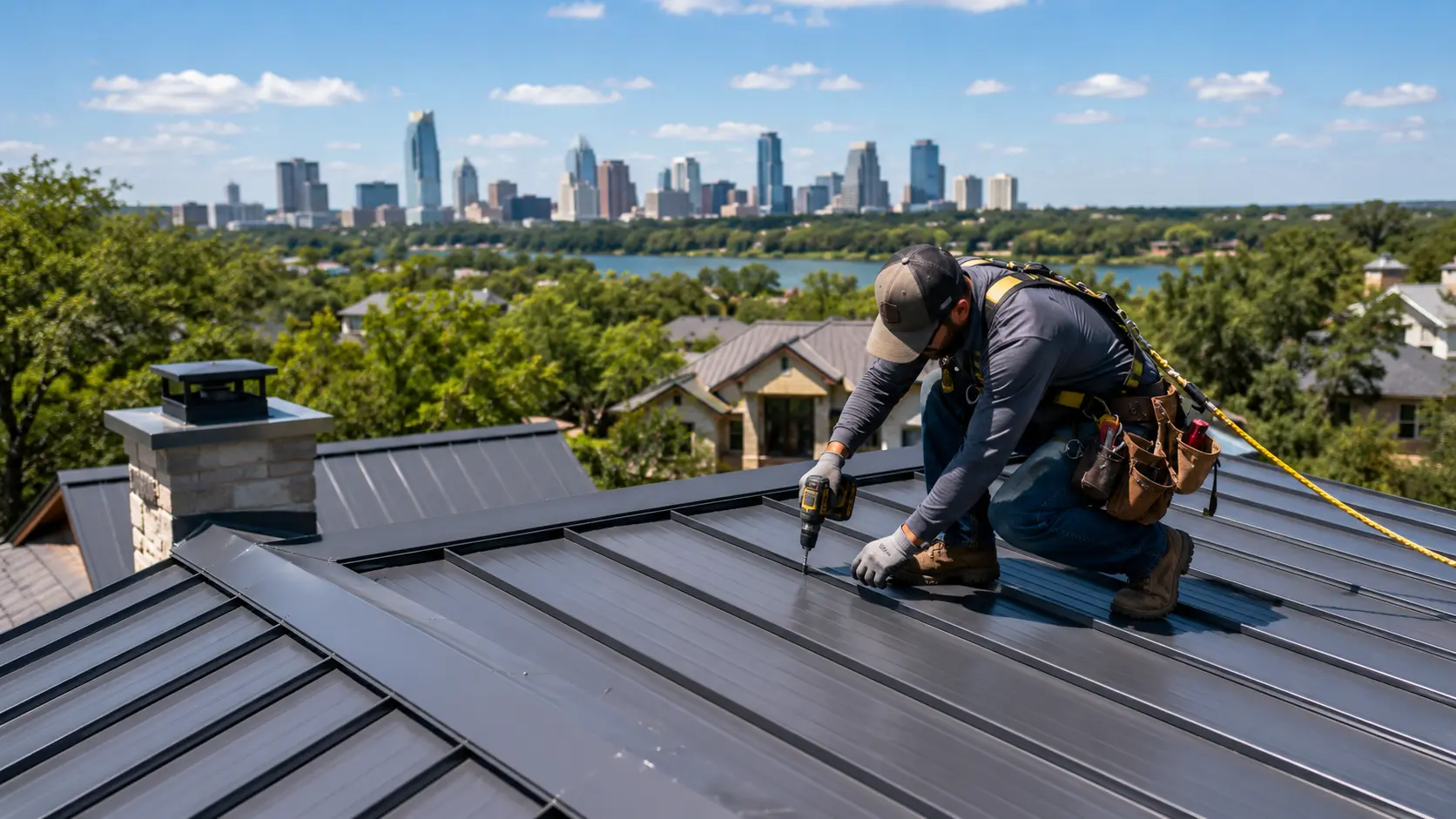
- In-house installation crews generally produce tighter seams, better warranty coverage, and cleaner documentation than subcontracted labor, which matters especially for insurance claims
- The most common cost underestimation isn’t materials: it’s the add-ons (decking replacement, flashing, ventilation upgrades) that don’t show up until demo day
- Metal roofs installed correctly in Central Texas can last 40 to 70 years, which changes the per-year cost math dramatically compared to asphalt
- If you have an active insurance claim or recent storm damage, the installation process and documentation requirements are different from a standard replacement
What Does Metal Roof Installation Actually Cost in Austin?
Metal roof installation is not a single price. It’s a range shaped by four variables: panel type, roof complexity, labor structure, and what the existing roof reveals once it comes off.
Here’s what the range looks like in Central Texas:
| Factor | Lower End | Higher End |
|---|---|---|
| Standing seam metal panels | $14,000 | $28,000+ |
| Exposed fastener metal panels | $10,000 | $18,000 |
| Roof size (1,500 sq ft vs. 3,000 sq ft) | Smaller footprint | Larger footprint |
| Simple gable roof vs. complex hip/valley | Straightforward | Multiple penetrations |
| In-house crew vs. subcontracted labor | Comparable upfront | Subcontract often cheaper quoted, more expensive corrected |
| Decking replacement (if needed) | Minimal | $1,500 to $4,000 added |
The table above compares the variables within a metal roof project, not metal against asphalt. That framing matters because most homeowners walk into this comparison asking the wrong question.
The wrong question is “how much does metal cost compared to shingles?” The right question is “how much does a roof that lasts 50 years cost per year compared to one I’ll replace twice in that span?”
A 30-year architectural shingle roof replaced twice over 60 years, with each replacement running $10,000 to $15,000, costs more in total than a single metal installation done right. The upfront number is real. The lifetime math is what actually matters.
Why Do So Many Austin Homeowners Underestimate the Final Number?
The gap between the quoted price and the final invoice usually isn’t dishonesty. It’s that legitimate unknowns don’t reveal themselves until the old roof comes off
Decking rot is the most common surprise. In Central Texas, heat cycles and humidity create conditions where OSB decking degrades from the underside while the shingles above still look passable. You won’t know how much it needs replacing until the demo. A typical decking replacement adds $1,500 to $4,000 depending on how far the damage runs.
Flashing is the second one. Metal roofing requires different flashing than asphalt at every penetration point: chimneys, vents, skylights, valleys. If a contractor quotes materials only and doesn’t break out flashing labor separately, that line item tends to grow.
Ventilation upgrades are the third. Metal roofs trap heat differently than shingles if the attic ventilation isn’t balanced. Some homes need ridge vent modifications or additional intake vents to prevent heat buildup that shortens the life of the roof from the inside out.
None of these are scams. They’re the honest reality of what a thorough job requires. The problem is that a quote that excludes them looks cheaper than one that includes them, and you can’t compare them accurately until you know which category each contractor’s quote falls into.
If you’re not sure what your current roof is hiding, a professional roof inspection in Austin before you commit to any installation quote gives you a baseline that makes every subsequent number easier to evaluate.
In-House Crew vs. Subcontracted Labor: Why This Decision Affects More Than Price
This is the part of the conversation most contractors skip, and it’s the one that matters most for long-term outcomes.
In-house installation means the company’s own employees do the work. Subcontracted installation means the company sells you the job and hires a separate crew, sometimes one they’ve used before, sometimes whoever’s available.
The distinction isn’t about skill. Subcontracted crews can be excellent. The issue is accountability structure.
When a crew is in-house, the company’s warranty is backed by people it can actually supervise and retrain. When something fails at a seam or a flashing point two years after installation, the company has direct control over the fix. When a subcontracted crew did the work, the chain of responsibility gets complicated fast.
For insurance claims specifically, this matters even more. If you’re filing a storm damage claim and the insurer wants documentation of the installation method, panel specs, and fastener pattern, an in-house crew produces that documentation as a standard part of the job. A subcontracted crew may not.
Roof It Pros uses in-house crews for metal installations, which means the before/after photo documentation, the warranty terms, and the installation accountability all sit with one company.
That’s not a small thing when you’re making a 40-year decision.
If you’re already dealing with storm damage and considering a metal upgrade as part of your replacement, the Austin metal roof installation process and the insurance documentation process need to run in parallel from day one.
What Happens When You Have an Active Insurance Claim?
Storm damage changes the installation conversation entirely. If hail or wind has compromised your existing roof, your insurance adjuster is looking at specific damage indicators, not at what you’d prefer to replace it with.
Here’s the common scenario: a homeowner files a claim, gets approved for an asphalt replacement, and then decides they want to upgrade to metal. The insurance payout covers the cost of like-for-like replacement. The difference between that payout and the metal installation cost is the homeowner’s responsibility.
That gap is real, and it’s worth knowing before you commit. A typical insurance payout for a 2,000 square foot asphalt replacement might be $8,000 to $12,000. A standing seam metal installation on the same roof might run $18,000 to $22,000. You’re covering the difference out of pocket.
What a knowledgeable contractor does in this situation is document the claim correctly so the insurance payout is maximized, then clearly separate what insurance covers from what the upgrade costs. That’s the honest version of insurance claim handling. The version to avoid is any contractor who implies insurance will “cover the whole metal roof” without explaining how that math works.
Roof It Pros has handled enough insurance claims to know exactly what adjusters look for and how to document damage in a way that supports the strongest possible payout. The roof repair and replacement process for Austin homeowners with active claims is different from a standard project, and treating it the same way is how people leave money on the table.
If you’re not sure whether your roof damage qualifies for a claim, start with an inspection from a certified roofing professional before you call your insurer. What gets documented in that inspection becomes the foundation of your claim.
A soft ask before you’re ready to commit: if you’re still in the “figuring out what I actually need” stage, Roof It Pros offers same-day availability for inspections in Austin and Pflugerville. That conversation costs you nothing and gives you real numbers to work with.
The Metal Roof Decision Framework: When It’s the Right Call and When It Isn’t
The Metal Roof Value Threshold is a simple decision filter: metal makes financial sense when at least two of the following four conditions are true.
- You plan to stay in the home for 10 or more years
- Your current roof is 15+ years old or has sustained documented storm damage
- Your attic insulation and ventilation are already adequate (or you’re budgeting to address them)
- You’re in a hail-prone area and want a Class 4 impact-resistant rating that may reduce your insurance premium
When only one condition applies, the upfront premium is harder to justify against a quality asphalt replacement. When two or more apply, the lifetime math shifts clearly toward metal.
This framework isn’t about steering you toward the more expensive option. It’s about giving you a way to evaluate the decision honestly before you’re in a contractor’s office.
For commercial properties in Austin, the calculus is different. Low-slope commercial roofs have different material requirements, and metal isn’t always the right system. The commercial roofing options available in Austin for flat or low-slope applications involve standing seam systems specifically engineered for that application, not the same panels used on residential pitched roofs.
What Metal Roofing Doesn’t Fix
Honest answer: a new metal roof doesn’t fix a drainage problem. If your gutters are undersized, improperly sloped, or pulling away from the fascia, a premium roof installation won’t prevent water intrusion at the eave line.
Central Texas summer storms produce rainfall intensity that overwhelms undersized gutters fast. If you’re replacing a roof, it’s worth having the gutter system evaluated at the same time.
The two systems work together, and addressing one without the other is a common source of callbacks that have nothing to do with the roof itself.
Metal roofing also doesn’t resolve attic moisture issues that originate from inside the home. Cooking steam, bathroom exhaust, and HVAC condensation that vents into the attic rather than outside will degrade any roof system from the underside. A thorough pre-installation inspection catches this. A rushed one doesn’t.
The most expensive mistake in roofing isn’t choosing the wrong material. It’s skipping the diagnostic step that would have told you what the material had to work with.