
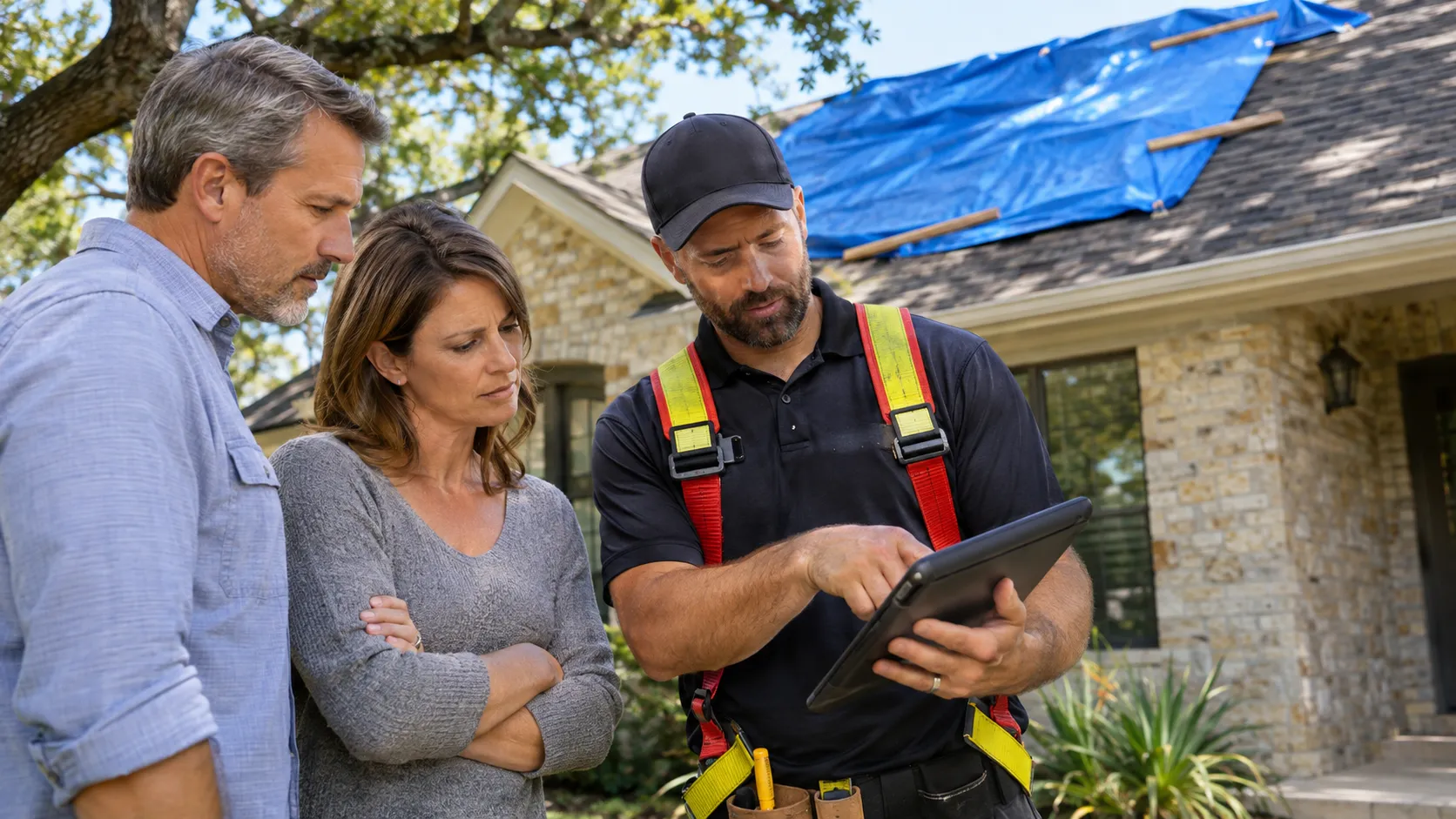
After a hailstorm, a ceiling stain or a yard full of shingle pieces raises one question fast: who calls the insurance company? Ask three people and you'll hear three answers. The real answer is split, and understanding the split protects your claim.
A roofer can inspect, photograph, estimate, and meet your adjuster. You, as the policyholder, file the claim and make the final decisions.
Key Takeaways
- You file the claim and sign the paperwork. Your roofer supplies the evidence and the technical explanation.
- Bring your roofer in before the adjuster visit, not after the denial.
- Emergency temporary roof tarping limits further damage, so keep the photos and receipts.
- Never accept an offer to waive or absorb your deductible.
- Get the scope in writing before any work begins, and know your wind and hail deductible.
What Does "Handling the Claim" Actually Mean?
A claim is a chain of tasks: reporting the loss, documenting it, inspecting with the carrier, agreeing on scope, receiving payment, and finishing the work. When someone says "my contractor handles it," they usually mean a few links in that chain.
Your part is reporting the loss, talking with the carrier about coverage, signing forms, and receiving payment. Your roofer's part is inspecting the roof, photographing damage, writing the scope of work, attending the adjuster meeting, and explaining line items in plain language. The adjuster works for the carrier and decides what the policy covers.
The claim stays in your name. A roofer who says "don't worry, we'll deal with everything" is describing convenience, and you still hold the decisions.
Why Do Claims Stall Even When a Roofer Is Involved?
Claims stall where the roofer's observations meet the adjuster's notes. An adjuster typically visits once and records what's visible during that window. Damage that wasn't photographed, marked, or pointed out often never makes it into the carrier's file.
Hail shows this clearly. Bruises on shingles and dents in soft metal are easy to miss without a slow, slope-by-slope inspection. If nobody who knows your roof is there when the adjuster arrives, the approved scope can come back smaller than the actual damage.
Most disputes come from gaps in evidence, not bad faith. Before-and-after photos fill the file before the carrier decides what belongs in it.
What Steps Should I Take, and Who Does Each One?
Follow this order:
- Protect the property. If water is getting in, arrange emergency temporary roof tarping. Roof It Pros provides prompt tarping for leaks and storm damage. Keep photos and receipts, since carriers generally expect you to limit further damage.
- Document before you file. Schedule a roof inspection. Roof It Pros offers a free inspection, so you'll have clear photos and written findings before you talk to the carrier.
- File the claim. This step is yours. Check your policy for the deductible, because many Texas policies carry a separate, higher wind and hail deductible.
- Meet the adjuster together. Your roofer walks the roof with the adjuster, points out damage, and answers technical questions while you stay the decision-maker.
After the carrier responds, compare its estimate to your roofer's scope line by line. If they differ, a supplement with supporting photos can explain the gap.
Consider a typical case: the adjuster approves repairs to two slopes, while the photos show bruised, brittle shingles on every slope. The supplement is where that difference gets argued with evidence instead of opinion. Whether the carrier agrees is its decision, and no roofer can promise the result.
How Does Acting Early Compare to Waiting or Going It Alone?
| Approach | What happens | Risk |
|---|---|---|
| Inspect with Roof It Pros first | Photos and written findings exist before the adjuster arrives | Lowest: evidence is in the file |
| Meet the adjuster alone | You rely on what the adjuster chooses to record | Hidden damage goes unmentioned |
| Wait and see | Leaks continue, deadlines approach | Interior damage and a carrier arguing you should have prevented it |
| Hire a door-knocking crew with no local address | Documentation and follow-up are uncertain | Nobody to call when a supplement question arises |
Waiting feels safe and is the most expensive move. Policies set reporting deadlines, and an untouched leak keeps adding interior damage.
When Do You Need More Than a Roofer?
A roofer isn't the right party to negotiate coverage, interpret policy wording for you, or represent you to the carrier. If the dispute is whether your policy covers something at all, a public adjuster or attorney handles that side. Your roofer's evidence of damage and cause still feeds into it, which is another reason to have a thorough inspection on record early.
What About Contractors Who Offer to Waive Your Deductible?
Walk away from any contractor who offers to absorb or hide your deductible. The deductible is part of your policy, and an invoice that doesn't match the real cost of the job is what gets claims flagged.
Storm season also brings crews who knock on doors and disappear. Roof It Pros has a physical location at 12711 Descartes Cove in Austin, with more than ten years in the roofing industry and a 5/5 Google rating across 80+ reviews from Austin and neighboring areas. If a question comes up months later, you know where to find us.
Does This Work the Same for Commercial Properties?
Mostly. The policyholder files and the roofer documents. Business owners and property managers often add layers, such as a landlord, lender, or lease that decides who reports damage. Confirm who holds the policy before anyone climbs a ladder. For TPO, EPDM, or modified bitumen systems, commercial roofing documentation should capture membrane damage, seams, and ponding, since adjusters often record only surface condition.
What Are the Realistic Limits?
No roofer controls what a carrier pays. We can provide clear findings, photos, and a written scope, but the coverage decision belongs to your insurer and your policy. Claims can be approved in full, in part, or denied for reasons like age, wear, or pre-existing damage. Timelines vary with carrier workload after major storms.
If the problem is old wear rather than a storm event, insurance may not apply, and you're facing a repair or replacement decision. Knowing which situation you're in before filing saves weeks. Our guide to hail damage roof repair in Austin shows what to look for, and our roof replacement page explains what happens if the damage is widespread.
Ready to Start With the Evidence?
If you suspect storm damage on your Austin home or business, start with documentation. Roof It Pros will inspect your roof for free, photograph what's there, and explain the findings in plain language before you decide what to file. Contact Roof It Pros to schedule, and bring your policy so we can talk through your next step.
Frequently Asked Questions
Can a roofer file my insurance claim for me?
No. You're the policyholder, so you file. A roofer provides photos, an estimate, and guidance on what to report.
Should I call my insurance or my roofer first?
If damage isn't obvious, get an inspection first so you know what to report. If there's an active leak, arrange tarping, then file promptly and check your policy's reporting deadline.
Will my roofer meet with the insurance adjuster?
A good roofer can attend the inspection, point out damage, and answer technical questions. You still make the decisions.
Does filing a claim raise my premiums?
It can, depending on your carrier and claim history. Your agent or insurer can explain how your policy treats it. A free inspection helps you decide whether a claim makes sense.
What if the adjuster's estimate is lower than my roofer's?
Your roofer can submit a supplement with photos and a line-item explanation. The carrier may revise the amount, but approval isn't guaranteed.
Can a contractor pay my deductible?
No. Decline any offer to waive or cover it. Billing that doesn't match real costs can jeopardize your claim.
Is emergency tarping covered by insurance?
It's often treated as a reasonable step to prevent further damage, but coverage depends on your policy. Keep photos and receipts. Roof It Pros provides emergency temporary roof tarping for leaks and storm damage.
About the Author
Brandon Miles is the CEO of Roof It Pros, a roofing company serving Austin and Central Texas. He leads a team that handles roof inspections, repairs, replacements, and storm damage work for homes and businesses, with an emphasis on honest guidance and clear communication.