
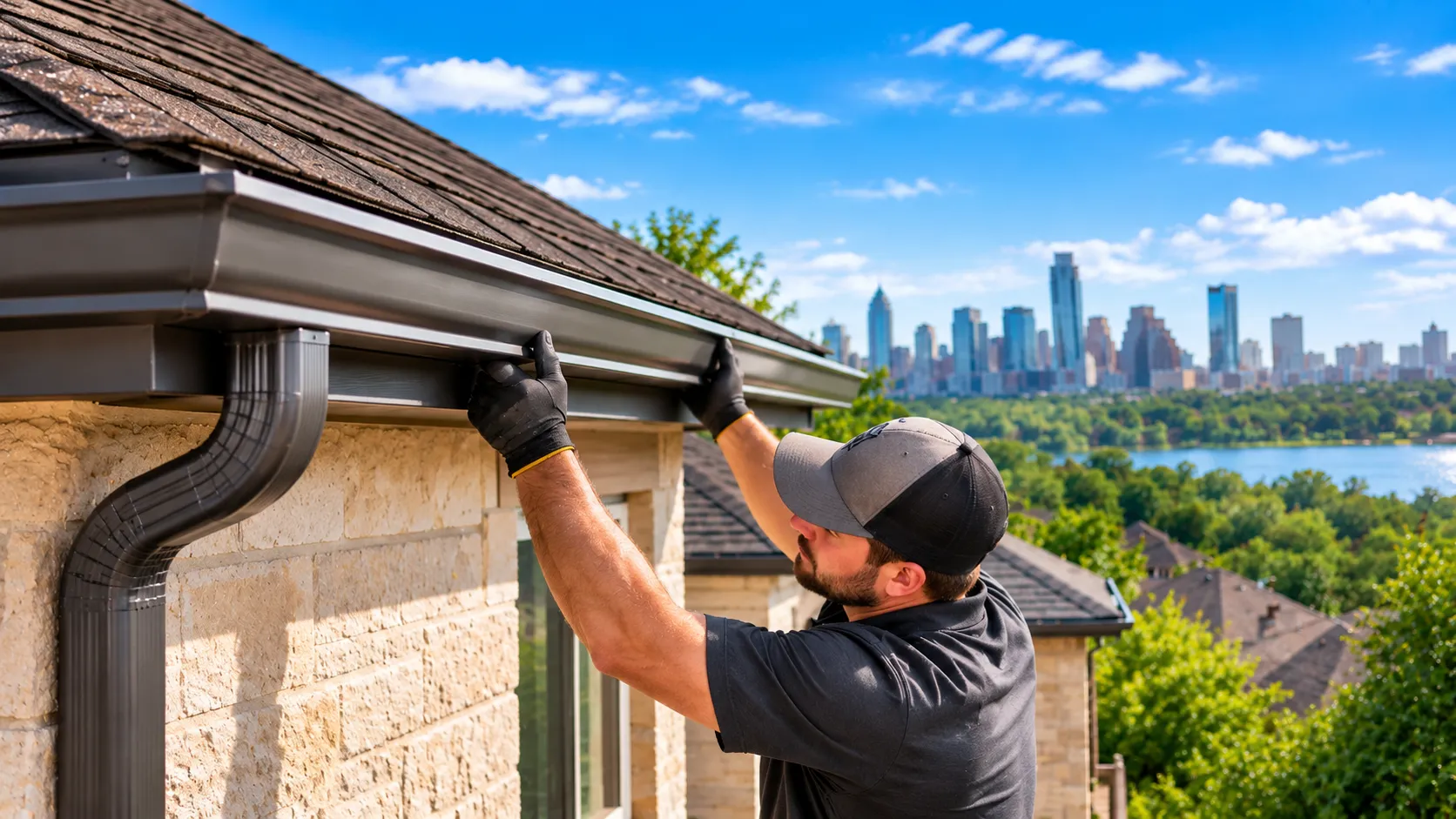
Your roof can be in excellent condition and still leave your home vulnerable to water damage.
The problem may not be the shingles, flashing, or roof structure. It may be the gutters responsible for directing thousands of gallons of rainwater away from your property throughout the year.
In Austin, Texas, sudden thunderstorms can produce heavy rainfall in a short period. When gutters are undersized, damaged, improperly installed, or clogged, water may overflow onto fascia boards, siding, landscaping, and areas near the foundation.
That's why rain gutter installation is more than a finishing detail on a home. It's part of an effective water management system.
For homeowners considering seamless gutter installation in Austin, understanding when to repair, replace, or upgrade an existing system can help prevent recurring drainage problems and unnecessary expenses.
Key Takeaways
- Seamless gutters are formed in continuous sections, reducing the number of joints along straight gutter runs where leaks may develop.
- Gutter replacement is worth considering when existing gutters have extensive corrosion, recurring leaks, poor alignment, or inadequate drainage capacity.
- Proper gutter sizing, slope, attachment, and downspout placement are just as important as the material selected.
- Austin's intense rainstorms make effective roof drainage particularly important for protecting fascia, siding, landscaping, and foundation-adjacent areas.
- Gutter installation costs depend on linear footage, material, home height, roof design, and the number of downspouts required.
- Roof It Pros serves homeowners in Austin, Pflugerville, and surrounding Central Texas communities with roofing services and related exterior drainage solutions.
Why Rain Gutters Matter for Austin Homes
Rain gutters collect water flowing off the roof and direct it toward downspouts, which discharge water away from the building.
Without an effective gutter system, rainfall can fall directly from roof edges and collect near the home.
Over time, concentrated runoff may contribute to soil erosion, damaged landscaping, staining on exterior walls, and moisture problems around vulnerable areas.
The amount of water involved can be substantial.
A roof with a 2,000-square-foot drainage area can collect approximately 1,247 gallons of water during a one-inch rainfall event, before accounting for losses and drainage differences.
That water needs somewhere to go.
When gutters and downspouts are properly designed, they help manage runoff and direct it toward appropriate discharge locations.
Why Central Texas Weather Makes Drainage Important
Austin experiences periods of intense rainfall, particularly during strong thunderstorms.
A gutter system that performs adequately during light rain may overflow when rainfall intensity increases.
This can happen because of inadequate gutter capacity, too few downspouts, poor slope, or debris accumulation.
For homeowners considering gutter installation in Austin, the objective should be a system designed for the property's actual roof area and drainage requirements.
What Are Seamless Gutters?
Seamless gutters are typically fabricated from continuous lengths of material sized to fit individual sections of a home.
Unlike traditional sectional gutters assembled from shorter pieces, seamless systems minimize joints along straight runs.
Corners, outlets, and end caps still require connections, but reducing the number of seams can lower the number of potential leakage points.
Seamless gutters are commonly available in aluminum and other materials, depending on the installer and project requirements.
Benefits of Seamless Gutter Installation
Fewer joints. Continuous sections reduce the number of connections that may loosen or leak over time.
Custom fit. Gutters can be fabricated to match the dimensions of individual roof edges.
Clean appearance. Long, continuous gutter runs can provide a streamlined look along fascia boards.
Reduced joint maintenance. Fewer seams may mean fewer locations requiring resealing or adjustment.
Material options. Homeowners can compare materials and finishes based on durability, appearance, and budget.
Seamless gutters are not maintenance-free.
They still require appropriate cleaning, secure attachment, and periodic evaluation to ensure water flows correctly.
Seamless Gutters vs. Sectional Gutters
Both seamless and sectional gutter systems can manage roof runoff when correctly installed and maintained.
The main difference is how the gutter sections are constructed and connected.
| Feature | Seamless Gutters | Sectional Gutters |
|---|---|---|
| Construction | Continuous lengths along each run | Multiple shorter sections |
| Joints | Primarily at corners, outlets, and end caps | Additional joints between sections |
| Custom fitting | Fabricated for the property | Assembled from standard lengths |
| Leak potential | Fewer joint locations | More connection points |
| Installation | Typically professionally fabricated | May allow simpler installation |
| Maintenance | Cleaning and periodic checks still required | Cleaning plus additional joint checks |
For many homeowners, seamless gutters are appealing because they reduce the number of connections along the roofline.
However, performance depends on the entire system, not just whether the gutters are seamless.
When Should You Replace Your Gutters?
Gutter replacement becomes worth considering when the existing system no longer manages rainfall effectively or requires repeated repairs.
Some problems can be corrected through cleaning, resealing, or replacing individual components.
Others indicate that a more comprehensive replacement may be the better long-term solution.
1. Water Overflows During Heavy Rain
If water consistently spills over the gutter edges, the system may be clogged, improperly sloped, or undersized.
Cleaning should be considered first when debris is present.
If the gutters are clear but still overflow, their capacity and downspout configuration may need evaluation.
2. Gutters Are Sagging or Pulling Away
Gutters should remain securely attached to the fascia or other appropriate structural support.
Sagging sections may indicate loose hangers, deteriorated fascia, excessive debris weight, or improper installation.
Minor attachment problems may be repairable.
Widespread deterioration can make replacement more practical.
3. Rust, Corrosion, or Cracks Are Developing
Different gutter materials deteriorate in different ways.
Steel gutters may develop corrosion, while other materials can experience cracking, distortion, or damage at connection points.
Small localized defects may be repairable.
Extensive deterioration across multiple sections can indicate that the system is nearing the end of its useful service life.
4. Leaks Keep Returning
A leaking gutter joint can sometimes be resealed.
However, repeated leaks at multiple locations may suggest aging materials, movement, or poor original installation.
When ongoing maintenance becomes frequent, replacing the affected runs may offer better value.
5. Water Collects Near the Foundation
Pooling water near the home may indicate that downspouts discharge too close to the building or that runoff is not being directed appropriately.
Gutter replacement alone may not solve this problem.
Downspout extensions, grading, drainage improvements, or other site-specific measures may also be necessary.
6. You're Replacing Your Roof
Roof replacement creates an opportunity to evaluate the existing gutter system.
If the gutters are damaged, undersized, or nearing the end of their useful life, coordinating gutter work with the roofing project may simplify scheduling and help ensure the components work together.
However, a new roof does not automatically require new gutters.
Gutter Repair vs. Replacement: Which Is More Cost-Effective?
The decision depends on the condition of the existing gutters and whether repairs can restore reliable drainage.
| Condition | Repair May Be Appropriate | Replacement May Be Better |
|---|---|---|
| Single leaking joint | Yes | Usually unnecessary |
| Loose hanger | Often | If attachment problems are widespread |
| Localized damage | Sometimes | If compatible repairs are impractical |
| Extensive corrosion | Limited | Often |
| Incorrect gutter capacity | Rarely solves the underlying issue | Consider redesign or replacement |
| Repeated leaks throughout the system | May become costly | Often worth evaluating |
| Poor downspout placement | May be corrected separately | Not always necessary |
A professional assessment should identify why the existing system is failing before recommending replacement.
What Size Gutters Do Austin Homes Need?
Gutter sizing depends on several factors, including roof area, roof slope, rainfall intensity, and the number and placement of downspouts.
Five-inch and six-inch gutters are common residential options, but neither size is universally appropriate.
A larger roof drainage area or high-volume runoff location may require additional capacity.
Five-Inch Gutters
Five-inch gutters are commonly used on residential properties with suitable drainage requirements.
They may be appropriate for certain smaller or simpler roof configurations.
Six-Inch Gutters
Six-inch gutters offer greater capacity than comparable five-inch profiles.
They may be considered for homes with larger roof areas, steep roof sections, or locations where runoff is concentrated.
Why Downspouts Matter Just as Much
Even appropriately sized gutters can overflow when there are too few downspouts or when the outlets cannot handle the incoming water.
Downspout sizing, placement, and discharge locations should be considered as part of the complete design.
A properly designed gutter installation accounts for the entire water flow path, from the roof surface to the final discharge point.
How Much Does Seamless Gutter Installation Cost in Austin, TX?
Seamless gutter installation costs vary depending on the home, material, and scope of the project.
Rather than relying on a single average price, homeowners should understand the factors that influence an estimate.
Linear Footage
The total length of guttering required is one of the primary pricing factors.
Homes with more roof edges, corners, and complex layouts may require additional material and labor.
Gutter Material
Aluminum, steel, copper, and other materials have different costs and performance characteristics.
Material selection should reflect the property's design, budget, and maintenance expectations.
Home Height and Accessibility
Two-story homes and difficult-to-access rooflines may require additional equipment and installation time.
Downspouts and Drainage Components
The number, size, and placement of downspouts affect the total installation scope.
Extensions or other drainage improvements may also be recommended when appropriate.
Existing Gutter Removal
Replacing old gutters may require removal and disposal of existing materials.
If fascia damage is discovered, additional repairs may be necessary before new gutters can be securely installed.
Gutter Guards and Accessories
Optional accessories can increase the initial cost.
Homeowners should evaluate whether these products are appropriate for their property rather than assuming they eliminate maintenance requirements.
A detailed estimate should identify the proposed gutter material, dimensions, linear footage, downspout configuration, and any additional work.
What Happens During Professional Gutter Installation?
A well-planned gutter installation involves more than attaching new material to the roof edge.
The process generally includes evaluating the roofline, determining drainage requirements, and planning the location of downspouts.
Step 1: Evaluate the Existing Drainage System
The installer examines the current gutters, fascia, roof edges, and runoff patterns.
This helps identify whether existing problems are caused by damaged materials, inadequate capacity, or poor drainage design.
Step 2: Measure the Roofline
Accurate measurements determine the lengths and configurations required.
For seamless gutters, the material is commonly formed on-site using specialized equipment.
Step 3: Plan Gutter Slope and Downspout Placement
Gutters require appropriate slope to move water toward outlets.
Downspouts should discharge water in locations that reduce the risk of pooling near the building.
Step 4: Secure the Gutter System
Gutters are attached using suitable hangers or fastening systems.
Secure installation is essential because gutters must support the weight of water and withstand normal weather exposure.
Step 5: Check Connections and Drainage
The completed system should be checked for proper alignment, secure attachment, and water flow.
Corners, end caps, and outlets require particular attention because they contain connections.
Do Seamless Gutters Need Cleaning?
Yes.
Seamless gutters reduce the number of joints, but they do not prevent leaves, roof granules, twigs, and other debris from entering the system.
Accumulated debris can block outlets and reduce drainage capacity.
In Austin, homeowners with nearby trees may need more frequent cleaning than properties with relatively clear rooflines.
Gutter guards may reduce the amount of certain debris entering the gutters, but they do not eliminate every maintenance requirement.
A practical maintenance plan includes checking gutters after significant storms, watching for overflow during rainfall, and arranging cleaning when debris accumulates.
How Gutters and Roofing Work Together
Your roofing system sheds water. Your gutter system collects and directs it away from the building.
When either component fails, moisture can reach areas that were not intended to remain exposed.
For example, damaged roof-edge flashing may allow water behind the gutters.
Likewise, gutters that overflow repeatedly can expose fascia and siding to concentrated moisture.
That's why roofing and gutter concerns should be evaluated together when there are signs of water damage.
For homeowners planning roof repair or replacement in Austin, it can be useful to discuss whether the existing drainage system remains appropriate for the updated roof.
Metal roofing also deserves particular attention because smooth roof surfaces can shed water efficiently during intense rainfall.
The right gutter design depends on the roof's characteristics and the property's drainage requirements.
Choosing a Gutter Installation Contractor in Austin
When comparing gutter installation companies, homeowners should look beyond the initial estimate.
A professional installer should be able to explain the recommended gutter size, material, attachment method, and downspout layout.
The proposal should also address any existing fascia damage or drainage problems that could affect the installation.
Useful questions include whether the system will be custom-fitted, how corners and outlets will be sealed, and what workmanship or material warranties apply.
Homeowners should also confirm that the contractor carries appropriate insurance and has experience with the type of gutter system being installed.
The lowest initial price may not represent the best long-term value if the installation does not address the property's drainage needs.
Roof It Pros: Roofing and Gutter Solutions in Central Texas
Roof It Pros is a family-owned roofing company serving Austin, Pflugerville, and surrounding Central Texas communities.
Led by CEO Brandon Miles, the company has more than a decade of experience helping property owners with residential roofing, commercial roofing, storm damage concerns, and related exterior protection needs.
Roof It Pros maintains a 5/5 Google rating across more than 80 reviews.
For homeowners experiencing roof-edge leaks, damaged gutters, or drainage problems, evaluating the roof and gutter system together can help identify the source of the issue.
Whether you're considering seamless gutter installation, replacing an aging system, or coordinating gutter improvements with a roofing project, the goal is the same: managing rainwater effectively and protecting the property.
Frequently Asked Questions
Are seamless gutters better than sectional gutters?
Seamless gutters have fewer joints along straight runs, which can reduce potential leakage points. However, both types can perform effectively when properly sized, installed, and maintained.
How long do seamless gutters last in Austin?
Service life depends on the gutter material, installation quality, maintenance, and weather exposure. Properly installed aluminum gutters can often remain serviceable for many years, but individual conditions vary.
How much does gutter installation cost in Austin, TX?
Costs depend on linear footage, gutter material, home height, downspout requirements, and additional work such as removing old gutters or repairing fascia. A property-specific estimate provides the most useful pricing information.
Should I choose five-inch or six-inch gutters?
The appropriate size depends on roof area, slope, rainfall intensity, and downspout capacity. Larger gutters may be beneficial for some homes, but proper drainage design matters more than choosing a size without evaluating the property.
Can damaged gutters cause foundation problems?
Poor drainage can contribute to excess moisture and soil erosion near a foundation. Whether it causes foundation damage depends on soil conditions, grading, drainage, and other property-specific factors.
Can I replace gutters without replacing my roof?
Yes. Gutters can generally be replaced independently when the roof edge and attachment surfaces are in suitable condition.
Do I need new gutters when installing a metal roof?
Not automatically. Existing gutters may remain appropriate if they are in good condition and have adequate capacity. The roof's drainage characteristics should be considered when planning the project.
Are seamless gutters maintenance-free?
No. They still require periodic cleaning and inspection. Seamless construction reduces joints but does not prevent debris accumulation or eliminate maintenance needs.
Can I replace only one section of my gutters?
In some cases, yes. Section replacement may be practical when the damage is localized and compatible materials are available.
What are signs that I need gutter replacement?
Recurring leaks, extensive corrosion, sagging sections, repeated overflow, and damaged attachment points can indicate that replacement is worth considering.
Get Help With Seamless Gutter Installation in Austin, TX
A reliable gutter system helps protect more than your roofline.
It directs rainwater away from vulnerable areas, reduces concentrated runoff, and supports the overall performance of your home's exterior.
If your gutters are leaking, sagging, overflowing, or no longer handling heavy rainfall effectively, it may be time to evaluate your options.
Roof It Pros serves homeowners throughout Austin, Pflugerville, and surrounding Central Texas communities.
Contact Roof It Pros to discuss your gutter installation or replacement needs and learn which solution is appropriate for your property.
About the Author
Brandon Miles is the CEO of Roof It Pros, a family-owned roofing company serving Austin and Central Texas. With more than a decade of experience in residential and commercial roofing, Brandon focuses on helping homeowners protect their properties through practical roofing solutions, storm damage services, and informed maintenance decisions.