
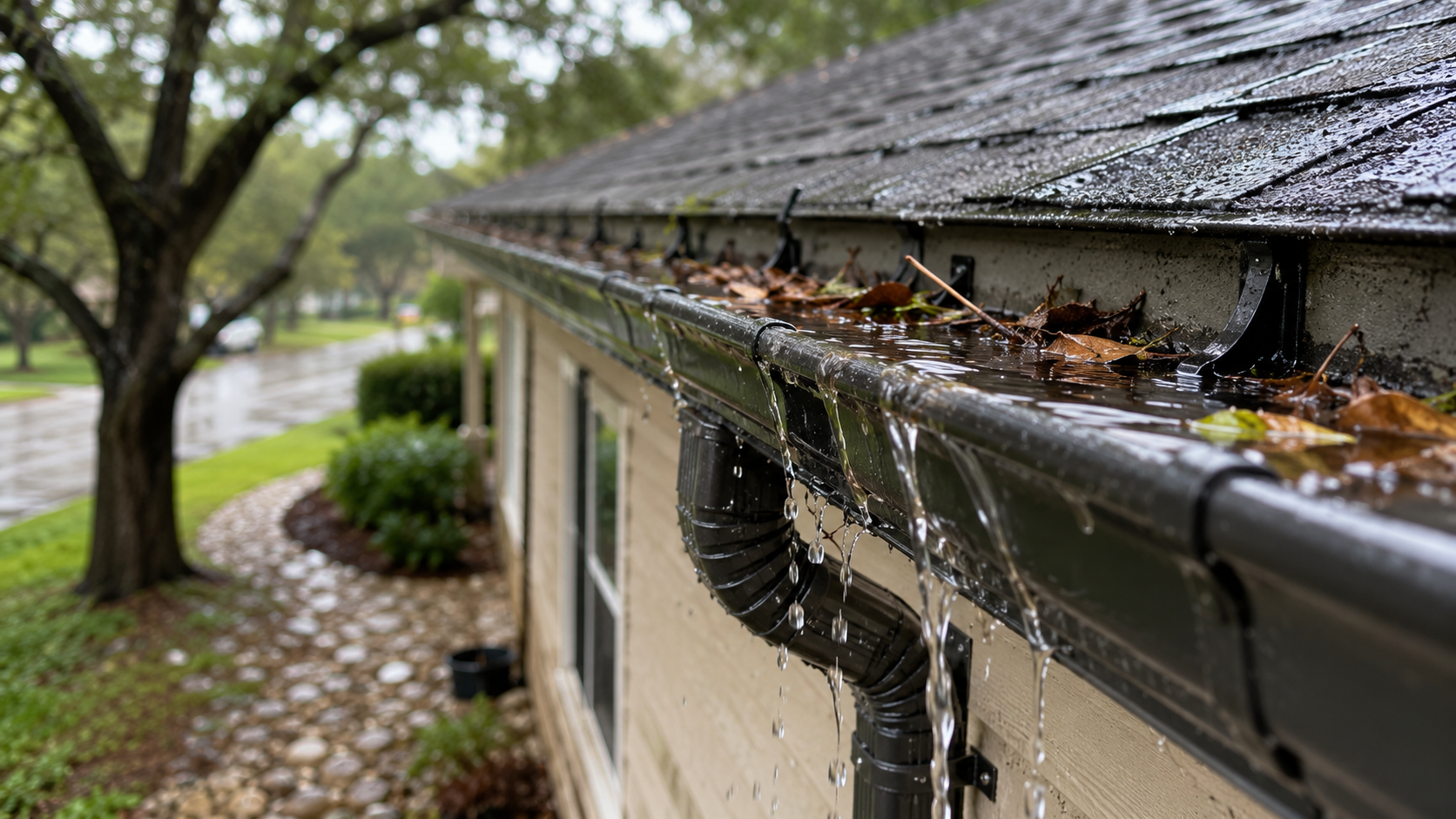
Your gutters look fine from the driveway. That’s the problem.
Most gutter failures in Central Texas don’t announce themselves until you’re looking at water damage behind your fascia board, a foundation that’s been quietly absorbing overflow for two seasons, or a roof edge that’s been rotting under a clogged channel nobody thought to check. By then, the gutter isn’t the issue anymore. The gutter was just where the problem started.
What’s the Direct Answer Here?
Conventional gutter installation fails Austin homeowners because it applies generic sizing standards and installation angles to a climate that doesn’t behave generically. Central Texas gets intense, fast-moving storms that overwhelm standard 5-inch gutters, combined with long dry periods that accelerate debris buildup. Getting it right requires storm-specific sizing, correct pitch calibration, and regular maintenance as a system, not a one-time install.
Key Takeaways
- Standard 5-inch gutters are frequently undersized for Austin’s high-intensity rainfall events, which can dump several inches in under an hour
- Incorrect pitch angle is the single most common installation error, causing standing water that accelerates corrosion and mosquito breeding
- Gutter installation without a downstream drainage plan just moves the water problem from your roof to your foundation
- Debris buildup in Austin’s oak and cedar canopy means gutters need cleaning at least twice a year, more after major storms
- Insurance claims for water intrusion tied to gutter failure are often denied when maintenance records don’t exist
Why Do Austin’s Storms Break Gutters That Work Fine Elsewhere?
Austin doesn’t get steady rain. It gets events. A storm that drops three inches in forty-five minutes doesn’t care what your gutter’s rated capacity is on paper. Standard residential gutters are typically sized for rainfall intensity rates that don’t account for the kind of short-duration, high-volume downpours Central Texas sees regularly, especially during spring and early summer.
The result is predictable. Water overshoots the gutter entirely, pours behind the fascia, and saturates the wood framing that your roofline depends on. You don’t see it happen. You see the damage six months later when the paint starts bubbling or the soffit starts to sag.
The gutter isn’t failing. It was never sized for the actual job.
This is the part most installation guides skip: local rainfall intensity data should drive gutter sizing decisions, not manufacturer defaults. A 6-inch K-style gutter with a 3×4 downspout handles significantly more volume than a standard 5-inch setup. In Austin’s storm profile, that difference isn’t a luxury upgrade. It’s the baseline.
If you’re unsure whether your current setup is undersized, a professional roof inspection in Austin will catch gutter sizing problems alongside any roofline damage they’ve already caused.
What’s the Real Root Cause of Gutter Installation Failures?
The root cause isn’t the gutters. It’s treating gutter installation as a product sale instead of a drainage system design problem.
Most conventional installs follow a simple formula: measure the linear footage, order the material, attach it to the fascia, done. That process ignores three things that matter enormously in Central Texas:
Pitch calibration. Gutters need a slight slope toward the downspout, typically about a quarter inch of drop per ten feet of run. Too flat and water sits. Too steep and it rushes past the downspout opening and overshoots. Most homeowners have no way to verify this was done correctly after installation.
Downspout placement and discharge. Where does the water actually go once it leaves the downspout? If it’s discharging within four feet of the foundation, you’ve solved the roof problem and created a foundation problem. Proper installation includes thinking about grade, splash blocks, and extension routing.
Fastener spacing and hanger type. Gutters loaded with water and debris are heavy. Hangers spaced too far apart let the gutter sag over time, destroying the pitch calibration and creating low spots where debris collects and standing water sits.
A common scenario: a homeowner in Pflugerville gets gutters installed by a general contractor who includes them as an add-on to a larger project. The gutters look clean and straight on day one. Eighteen months later, there’s a visible sag in the middle run, water is pooling against the foundation on the east side of the house, and the fascia behind the gutter has soft spots. None of this was visible from the driveway. All of it was preventable.
How Do You Actually Get Gutter Installation Right in Central Texas?
Getting it right means treating the gutter as part of your roof system, not a separate accessory bolted to the edge of your house.
Here’s what a properly executed installation actually involves:
- Sizing based on your roof’s square footage and pitch, not a default product selection
- Pitch verification with a level during installation, not by eye
- Downspout sizing and placement calculated for volume, not just aesthetics
- Discharge routing that directs water away from the foundation
- Fascia inspection before installation, because attaching gutters to rotting wood just delays the next failure
The Roof It Pros team approaches gutter installation in Austin as a drainage system problem from the first measurement. That means checking the condition of your roofline before a single bracket goes up, because installing new gutters over damaged fascia is one of the most expensive mistakes a homeowner can make.
If you’re already seeing water staining on your siding, soft spots near your roofline, or foundation cracks that seem to track with your downspout locations, don’t wait for the next storm to confirm the pattern. Schedule an inspection now before the repair scope grows.
Contact Roof It Pros to get a proper assessment of your current gutter system and what it would take to fix it.
How Does Proper Installation Compare to the Alternatives?
| Approach | Upfront Cost | 2-Year Risk | What You're Actually Betting On |
|---|---|---|---|
| Properly sized and pitched installation with drainage plan | Moderate | Low | System works as designed through storm season |
| Standard 5-inch install, no pitch verification | Low | High | Works until the first major event or debris load |
| DIY gutter repair or partial replacement | Lowest | Highest | No fascia inspection, no pitch calibration, no warranty |
| Doing nothing / delaying after visible damage | Zero | Severe | Foundation, fascia, and interior water damage compound silently |
The table makes the math clear: the cheapest option at installation is almost always the most expensive option over two years. Water damage to fascia, soffit, and foundation repairs costs multiples of what proper gutter installation would have cost. Waiting isn’t free. It’s just deferred payment on a larger bill.
What Does Gutter Maintenance Actually Require in Austin?
Installation is only half the answer. This is the follow-up question most homeowners ask once they understand the sizing and pitch issues.
Austin’s tree canopy, particularly live oak and cedar, generates year-round debris. Gutters that were installed correctly can still fail if they’re not cleaned regularly. Standing debris creates the same overflow problem as an undersized gutter, and it accelerates corrosion in aluminum systems.
The practical standard for Central Texas: clean gutters at minimum twice a year, and after any significant storm that drops heavy leaf or branch debris. If you have large trees overhanging your roofline, quarterly cleaning is more realistic.
Roof It Pros offers gutter cleaning in Austin as a standalone service, and it’s worth pairing with your annual roof inspection so both happen on the same visit. That combination, a clean gutter system and a documented roof condition check, is also the maintenance record that supports an insurance claim if water intrusion occurs later.
Speaking of which: if you’ve had recent storm damage and aren’t sure whether your gutters or roof were affected, the residential roofing team at Roof It Pros handles insurance documentation and claim support as part of the inspection process.
When Is This Approach Not the Right Fit?
Straight talk: not every gutter situation needs a full replacement or a system redesign.
If your gutters are less than five years old, properly sized, and showing no signs of sagging or overflow, the issue may be purely maintenance. A cleaning and inspection will tell you quickly.
This approach also isn’t a substitute for roof repair in Austin when the underlying damage is to the roof deck or fascia. Gutters attached to compromised wood will fail regardless of how well they’re installed. The gutter work has to come after the structural repair, not before.
And if you’re a commercial property owner dealing with flat roof drainage issues, that’s a different system entirely. Roof It Pros handles commercial roofing in Austin separately from residential gutter work, because the drainage engineering for a commercial flat roof has almost nothing in common with residential K-style gutters.
The right question to ask before any gutter work: what is the actual condition of the fascia and roofline right now? That answer determines the correct sequence of work.